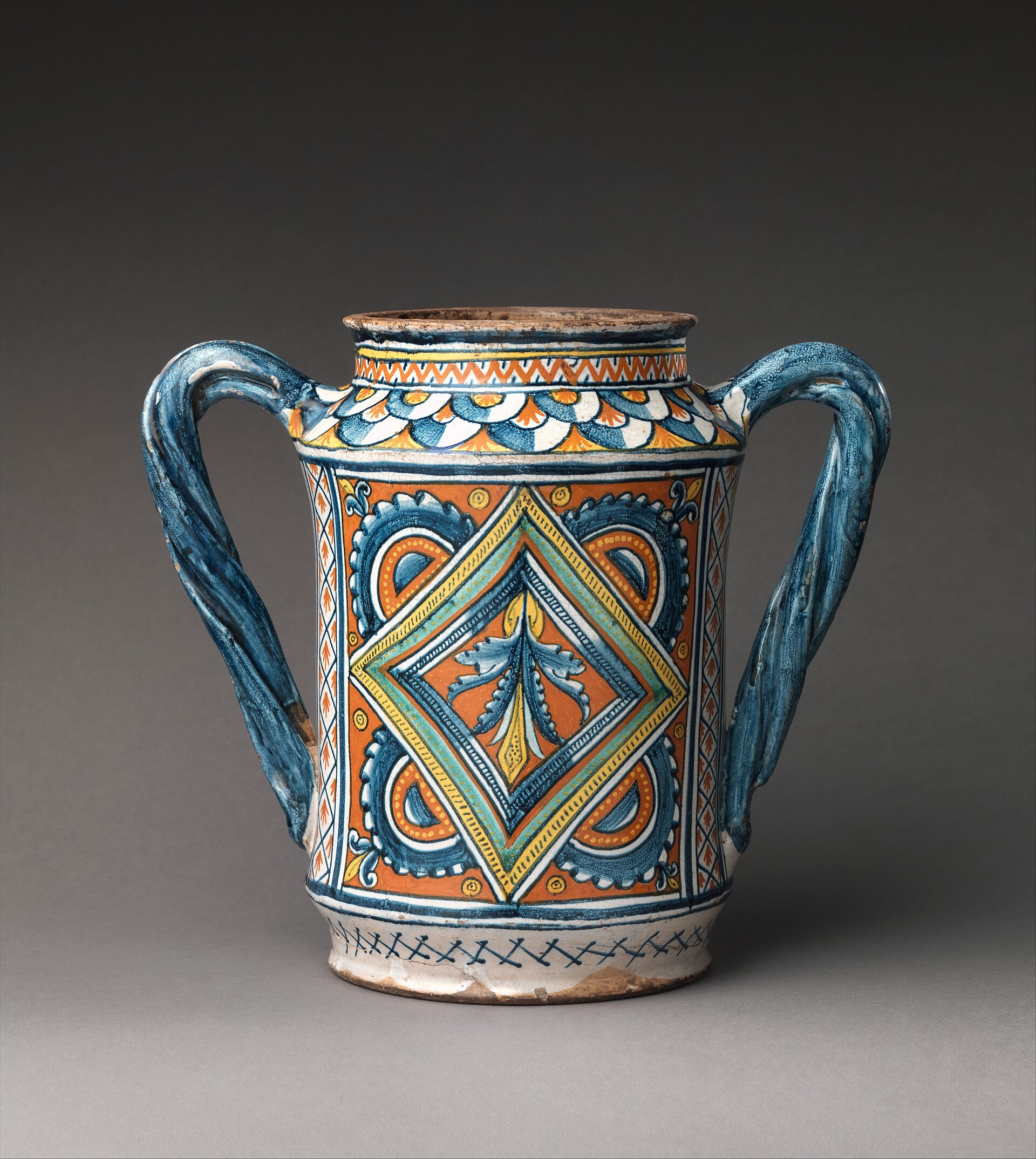
A maiolica plate looks, at first glance, like porcelain: a bright white ground carrying sharp, saturated colour, fired hard and glassy. It is neither porcelain nor, strictly, white. Underneath the glaze sits ordinary red earthenware, the same coarse, iron-rich clay used for roof tiles and flowerpots across central Italy, dug locally rather than imported. What turns that red clay white is a glaze loaded with tin oxide, which goes cloudy and opaque in the kiln and buries the clay’s colour under an even, ceramic-white surface ready to be painted.
Painting on it is unforgiving. Pigments made from metallic oxides, cobalt for blue, copper for green, antimony for yellow, sink into the unfired glaze the way ink sinks into blotting paper, so a brushstroke cannot be wiped away or corrected once made; the painter effectively works in fresco, on a much smaller and far more breakable canvas. Getting an elaborate scene right in a single pass, without a mistake, was itself a demonstration of skill, since a botched dish generally could not be salvaged and had to be scrapped before it ever reached the kiln. By the fifteenth century one town in Romagna had built an international reputation on doing it consistently well, at a volume its neighbours could not match.
That town was Faenza, and its name is the reason the French, and later the English, call this kind of pottery faience.
The town that named a technique
Faenza had been producing fine maiolica since at least the early 1400s, and by the following century its wares were reaching markets across France in such quantity and with such consistent quality that French buyers stopped asking for “pottery from Faenza” and simply started calling all tin-glazed earthenware faïence, regardless of where in Italy, or later France and the Netherlands, it had actually been made. It is a rare case of a European craft term derived directly from a single production town, still in everyday use in French and English centuries after most buyers have forgotten where the word came from. The town’s own kilns worked continuously through that period on the strength of the trade, exporting dinner services, apothecary jars and devotional plaques as far as royal households outside Italy, at a moment when a fine ceramic service could serve as a diplomatic gift in its own right.
Istoriato and the rival towns
Faenza’s technique spread quickly to other central Italian towns, several of which developed their own specialities, so that by the sixteenth century a buyer could tell where a piece of maiolica had been made almost as easily as a modern collector can tell one country’s porcelain from another’s. In Urbino, a hill town already known for its ducal court and its painters, ceramicists working in the early sixteenth century pioneered istoriato ware, literally “storied” or narrative pottery, which covered an entire plate or dish with a single detailed scene from mythology, scripture or ancient history, treating the ceramic surface the way a panel painter might treat wood. Nicola da Urbino and Francesco Xanto Avelli were among the style’s most accomplished practitioners, producing services that noble households commissioned as much for display as for the table. A single istoriato plate could take a skilled painter the better part of a day to complete, working directly from a print or drawing propped beside the wheel, and the finished piece was expected to be recognised across a dinner table as a specific scene, not merely admired as decoration.
Deruta’s gold and ruby
The Umbrian town of Deruta took a different route. Its first documented workshop dates to around 1401, and by the early sixteenth century Deruta had become, alongside Gubbio, one of the two great centres of Italian lustreware: a technique that applied a second, metallic glaze over the tin-glazed and already-fired surface, then fired the piece again at a lower temperature in a smoky, oxygen-starved kiln that left a thin, iridescent film of gold or ruby-red on the surface. The effect, when it worked, looked almost like beaten metal laid over paint. It was also unreliable and expensive, since a poorly controlled firing could ruin days of painting in a single attempt, which is part of why fine lustreware never became cheap and never stopped being prized. At the trade’s sixteenth-century peak, Deruta supported roughly fifty active kilns; by the middle of the nineteenth century, as fashion moved on and cheaper transfer-printed pottery undercut hand-painted ware, only a handful remained in business. Deruta ceramics are nonetheless still exported worldwide today, and its Museo Regionale della Ceramica holds more than seven hundred maiolica tiles tracing the tradition’s development.
Rebuilt after 1944
Faenza’s own account of the wider craft is kept at the MIC, the Museo Internazionale delle Ceramiche, founded in 1908 by the scholar Gaetano Ballardini specifically to document ceramic traditions from around the world, not just Faenza’s own. The Second World War came close to destroying that project outright: fighting near the Gothic Line brought serious wartime damage to the city and its museum in 1944, and a significant part of the collection was lost or damaged before it could be moved to safety. Faenza rebuilt the museum in the years that followed, drawing on donations and loans to refill galleries that had been stripped of much of their historic collection. MIC today holds ceramics ranging from pre-Columbian and ancient Mediterranean pieces to twentieth-century work by artists including Picasso and Matisse, alongside the historic maiolica that gave the institution its original purpose, a deliberately global collection built on the premise that Faenza’s own tradition can only be understood next to everyone else’s.
Faenza’s UNESCO year
The museum has run the Premio Faenza, an international prize and biennial exhibition for contemporary ceramic art, since 1938, giving the town a continuous showcase for new work even as its historic wares sit a floor away in the permanent collection. In 2025, that unbroken relationship between craft and city was formally recognised: Faenza joined the UNESCO Creative Cities Network in the Crafts and Folk Art category, citing the ceramic tradition that gave the world the word faience as central to the city’s identity. Workshops making both traditional istoriato-style ware and contemporary studio ceramics remain active across the town today, working glazes and firing schedules that, in their essentials, have not changed since Ballardini first began collecting them. The next Argillà Italia fair, the open-air ceramics market Faenza holds annually around the museum, will draw makers from Deruta, Urbino and Gubbio back into the same streets where their towns’ rival techniques were first traded against one another five centuries ago.
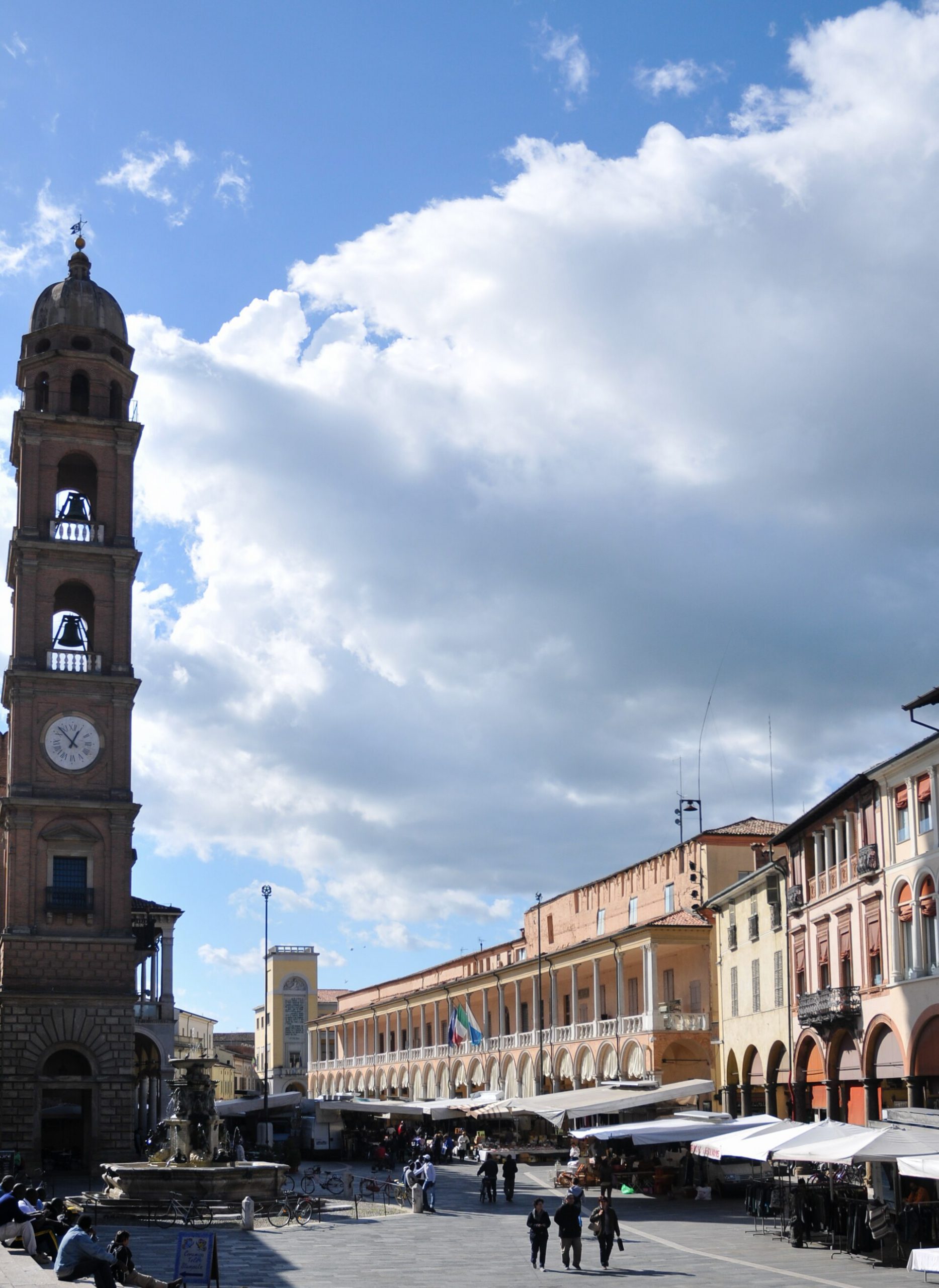
Lead image: Faenza, Emilia-Romagna. The French word faience derives from the town’s name. Photo: CC BY-SA 4.0 via Wikimedia Commons.