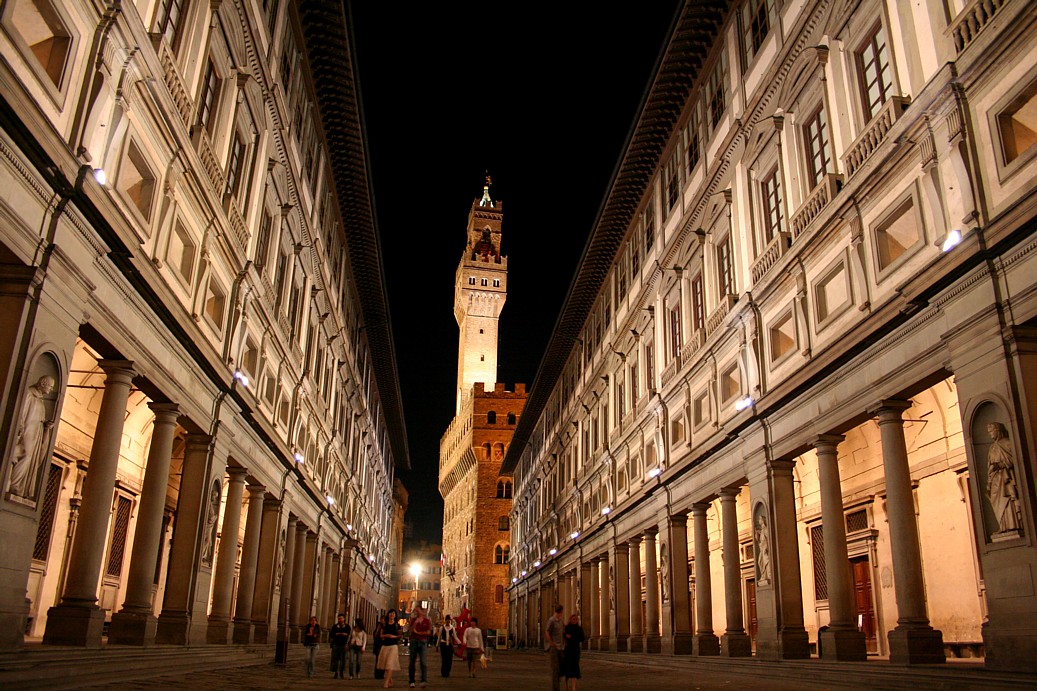
In 1560, Cosimo I de’ Medici set Giorgio Vasari to work on a building that had nothing to do with art. The Duke wanted Florence’s scattered magistracies, guilds and administrative bodies gathered under one roof, on a plot beside the Palazzo Vecchio running down to the Arno. Vasari called it the Uffizi, simply “the offices”, and built two long parallel wings joined by a loggia, framing a narrow street-like courtyard open to the river. Construction dragged past his death in 1574; Bernardo Buontalenti finished the top floor for Francesco I, who had already begun installing Medici treasures there instead of clerks.
Today around 5.3 million people a year queue outside that same U-shaped courtyard to see Botticelli’s Birth of Venus, Piero della Francesca’s Montefeltro diptych and Caravaggio’s Medusa. The building’s civic function is long gone, but its name still carries the memory of it: a museum whose galleries were once corridors of desks, and whose grandest rooms were originally meant for filing cabinets rather than canvases.
The offices that became a gallery
Francesco I turned the top-floor loggia into a place to display Medici sculpture and curiosities from around 1581, and by the following century the family’s paintings, armour and scientific instruments had filled most of the upper storey. The offices themselves migrated elsewhere over the eighteenth and nineteenth centuries. What began as Cosimo’s bureaucratic solution became, almost by accident, one of the first purpose-arranged public art galleries in Europe, opened to visitors on request from the 1760s onward under Grand Duke Peter Leopold.
A pact that keeps the collection in Florence
The single document that shaped the Uffizi’s future was signed in 1737 by Anna Maria Luisa de’ Medici, the last of her line, a few months after the death of her brother Gian Gastone left the grand ducal title to the Austrian House of Lorraine. Her Patto di Famiglia, or Family Pact, handed over the Medici’s accumulated paintings, sculpture, libraries and furnishings on one binding condition: none of it could ever be removed from Florence or the Grand Duchy. The pact treated the collection as a possession of the city rather than of any ruling house, and it is the reason the Uffizi’s core holdings were never dispersed to Vienna, sold off by later rulers or broken up as dynasties changed.
That condition has held through two more centuries of political upheaval, including the brief Napoleonic annexation of Tuscany, the restoration of the Lorraine grand dukes after 1815, and the unification of Italy in the nineteenth century, when many other princely collections were absorbed into national capitals or dispersed among competing heirs. The Uffizi’s Medici core stayed put, which is why the gallery still reads, in places, like the private collection it once was.
The night the Mafia bombed via dei Georgofili
At 1.04am on 27 May 1993, a car bomb containing roughly 227 kilograms of explosive detonated outside the Torre dei Pulci on via dei Georgofili, a few metres from the Uffizi’s west wing. The Sicilian Mafia planted it in retaliation for the state’s crackdown following Salvatore Riina’s arrest that January; the same campaign targeted sites in Rome and Milan. Five people died, including two young sisters, and 48 were injured. Roughly a quarter of the works held in the Uffizi and the Vasari Corridor suffered damage, and three paintings, among them Bartolomeo Manfredi’s Card Players, were destroyed beyond repair.
The Georgofili Academy building next door collapsed entirely. The Uffizi’s own west facade and several ground-floor rooms had to be rebuilt, and the museum stayed partly closed for months. Investigators eventually traced the bombing to the same Mafia campaign responsible for attacks in Rome and Milan that year, and successive trials sent Salvatore Riina, Giuseppe Graviano, Leoluca Bagarella and Bernardo Provenzano to prison for life, alongside lesser sentences for others who later cooperated with prosecutors. A permanent commemorative space near the site now documents the damage and the restoration that followed, a rare instance of a museum keeping the record of an attack against it on public view rather than erasing it.
Doubling the exhibition space
By the early 2000s the Uffizi was showing a fraction of its holdings in rooms designed for sixteenth-century bureaucrats, not modern crowds. The Nuovi Uffizi programme, rolled out in phases from 2006 into the 2010s, more than doubled the display area, from about 5,400 to 12,000 square metres, and reorganised the collection into colour-coded suites opened one at a time: blue for Netherlandish, Spanish and Dutch painting in December 2011, red for sixteenth-century Florentine work the following June, yellow for the following century in December 2013, and green for classical marble sculpture in February 2014. A new south-wing exit and additional stairwells eased what had been one of the worst bottlenecks of any major European museum, where visitors had once had to file back out through the same single corridor they entered by.
Director Simone Verde, who took over in early 2024, announced a further €50 million programme in 2026 covering the Uffizi, Palazzo Pitti and the Boboli Gardens together, funded jointly by ticket revenue and the Italian culture ministry. Plans include a new introductory exhibition on the collection’s own history and a conversion of the so-called Piano degli Occhi into additional gallery space, with the full programme expected to run over roughly two years.
The corridor reopens
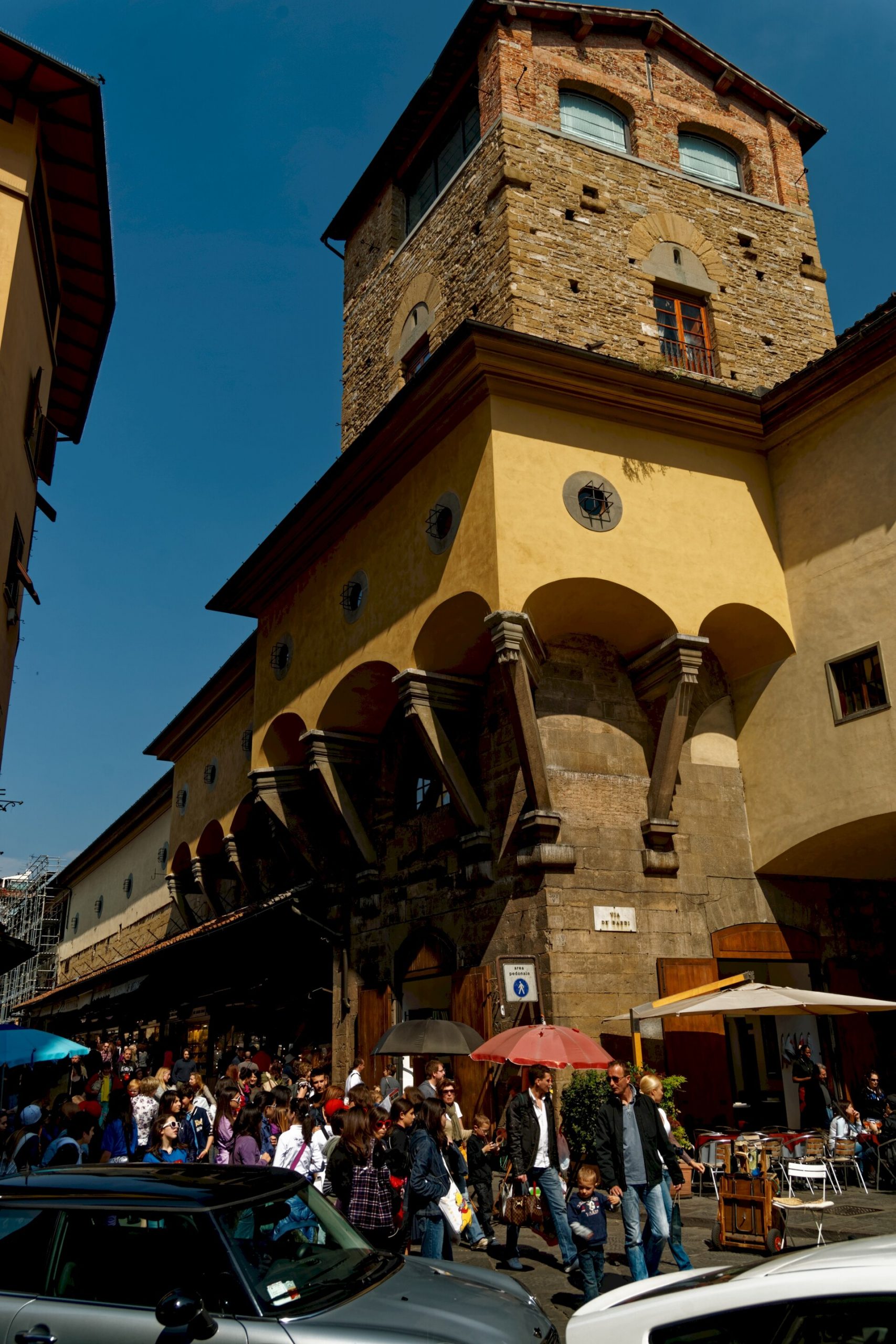
Vasari’s other major contribution to the site, the 750-metre elevated passage that bears his name, closed to the public in 2016 for a structural and safety overhaul. Built in five months in 1565 so Cosimo’s heirs could cross from the Palazzo Vecchio to the Pitti Palace over Ponte Vecchio without setting foot in the street, the corridor reopened on 21 December 2024 after an eight-year closure, fitted for the first time with ramps and lifts for full accessibility. Visitors now book a fixed time slot, pay a supplement on top of the standard Uffizi ticket, and walk the route in groups capped at 25, emerging past the goldsmiths’ shops on the bridge and on to Boboli.
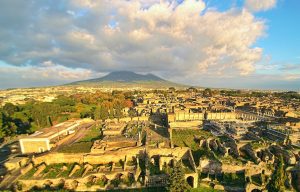
The Uffizi finished 2024 as Italy’s second most-visited state museum after the Colosseum Archaeological Park, which drew nearly 15 million visitors that year, and ahead of Pompeii’s roughly 4.2 million; the Uffizi itself drew 5,294,968 visitors and generated gross revenue of €61.9 million, according to figures released by the culture ministry. Verde’s redevelopment work is under way through 2026 and 2027, room by room, while the galleries stay open; the Vasari Corridor, closed to the public for most of living memory, is for the first time simply another ticket on the same booking page.
Lead image: The Uffizi, built from 1560 to house Florence’s magistrates, seen from the Piazzale degli Uffizi.