In June 2023, in the atrium of a house in Regio IX, archaeologists uncovered a fresco of a silver tray holding a round flatbread called a mensa, a wine cup, a pomegranate, dates and a garland of dried fruit. Photographs of it went around the world within days, most of them captioned as a two-thousand-year-old pizza. The Archaeological Park of Pompeii had to issue a correction: no tomatoes and no mozzarella existed in the Roman world, and the bread pictured was closer to a modern focaccia, painted as an offering of hospitality in the Greek xenia tradition later described by Virgil and Martial. The confusion said something true about the last three years at Pompeii: a site excavated on and off since 1748 is still capable of producing images that need explaining to a global audience within a single news cycle.
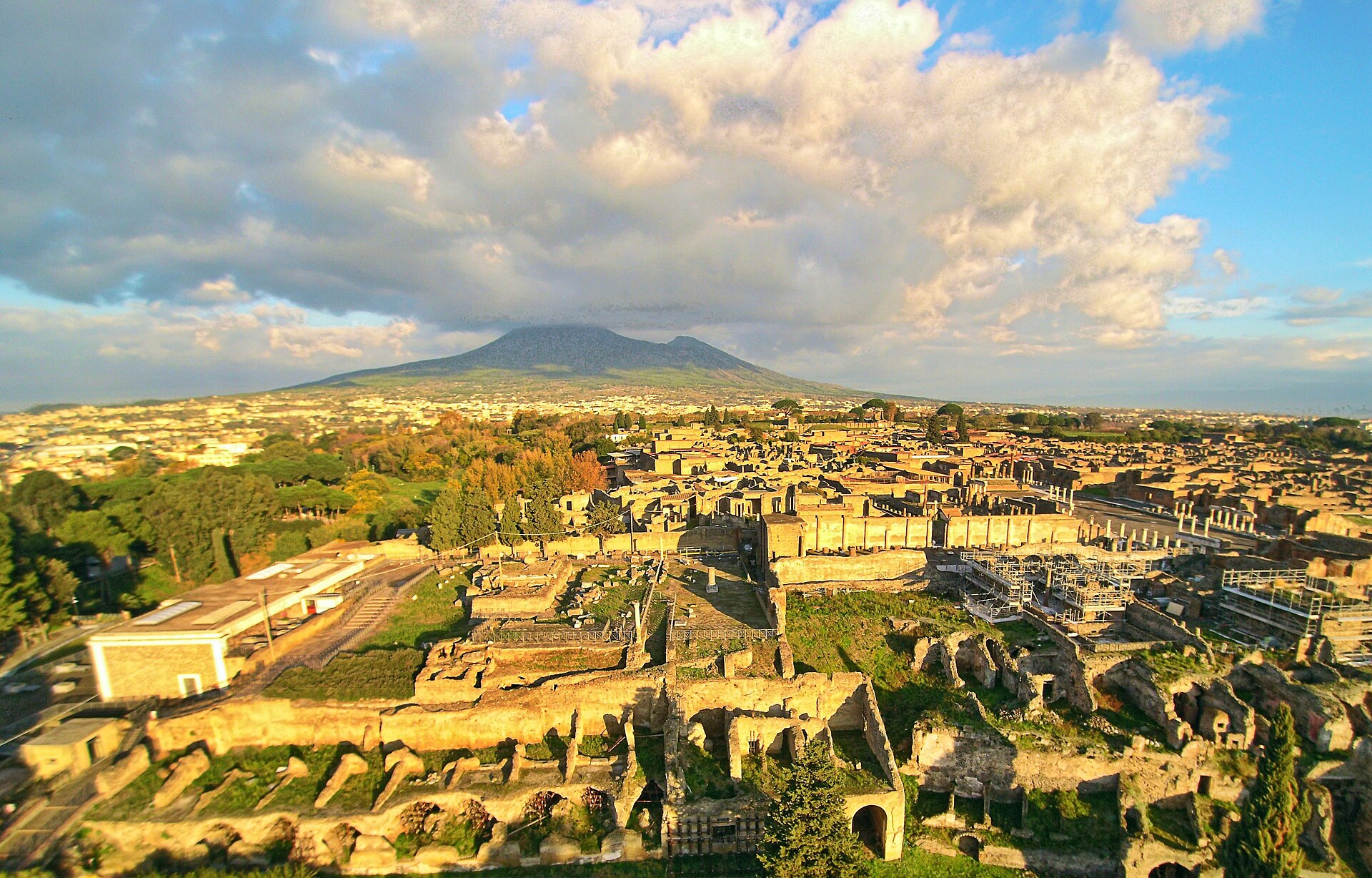
Pompeii covers roughly 66 hectares behind its walls, and about a third of that area has never been touched by an archaeologist’s trowel, buried under the same volcanic material that killed the city in 79 CE. Regio IX, the district bounded by via di Nola, via Stabiana and via dell’Abbondanza, sits close to the town centre and had remained largely unexcavated until a new campaign began there in 2023. It is not a rescue dig in the usual sense. The work is driven by a need to secure exposed embankments left by nineteenth- and twentieth-century digging nearby, which meant cutting a new excavation front through ground that turned out to be extraordinarily rich.
A bakery that was also a prison
The clearest evidence of Pompeii’s harsher side surfaced in December 2023, in a cramped building attached to a private house in Regio IX. Rooms too narrow for two donkeys to pass side by side held rotary mills, or molae asinariae, worn smooth by the animals and enslaved labourers who pushed them round for hours to grind grain into flour. The building’s few windows sat high in the walls and were barred with iron. Gabriel Zuchtriegel, the park’s director since 2021, described the space as one “in which we have to imagine the presence of people of servile status whose freedom of movement the owner felt the need to restrict.” Grooves worn into the floor appear to mark the paths the blindfolded animals and their human counterparts walked, over and over, in the dark.
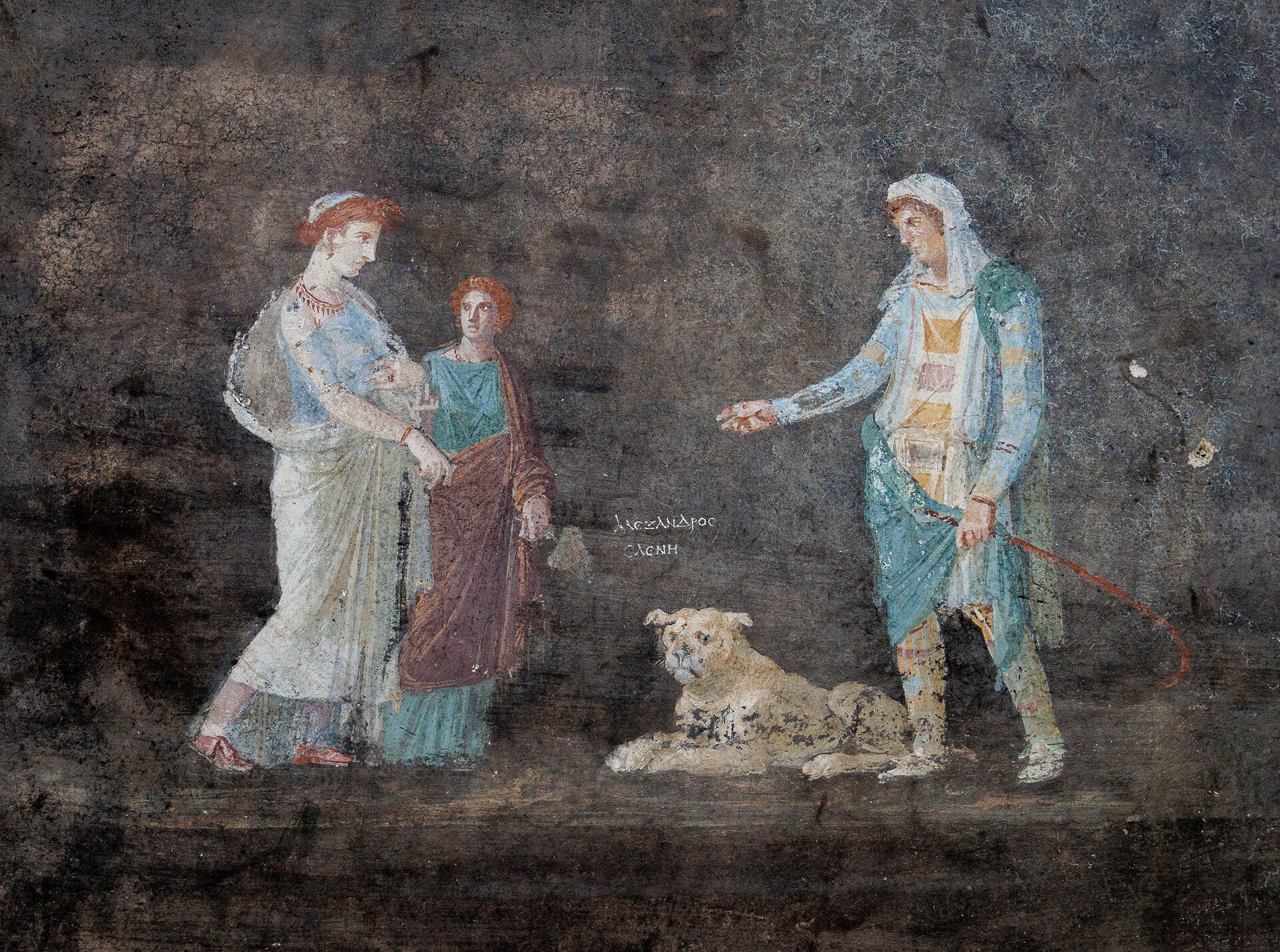
A dining room painted for lamplight
Four months later, in April 2024, excavators reached a banqueting hall roughly 15 metres long and 6 metres wide, its walls painted almost entirely black. Zuchtriegel explained the choice as practical rather than decorative: black surfaces hid the soot that oil lamps left behind on plaster during long evenings of dining. Against that dark ground, a painter had set scenes from the Trojan War in vivid colour, including Helen’s meeting with Paris, identified by a Greek inscription naming him “Alexandros”, and Cassandra beside Apollo, the god who cursed her prophecies to go unbelieved. By lamplight and after wine, the excavators noted, the figures were designed to seem to move. The room opened off a courtyard with its own staircase to an upper floor, suggesting a household with enough space and money to build a dedicated space purely for entertaining.
A shrine painted the colour of the sky
Two months after that, in June 2024, a smaller and stranger room turned up nearby: a sacrarium, a household shrine, its walls covered edge to edge in a saturated blue pigment rarely found intact on this scale anywhere in the Roman world. Painted onto the blue ground were female figures read as personifications of the four seasons, alongside allegorical scenes of agriculture and pastoral life. Excavators recovered amphorae, a pair of bronze jugs and two bronze lamps inside the room, along with construction debris that included seashells mixed into the wall plaster, evidence that the space was being renovated when Vesuvius erupted. Italy’s then culture minister, Gennaro Sangiuliano, said the chamber was likely used for ritual activity and for storing sacred objects belonging to the household.
What the unfinished walls reveal
A find made in January 2023 but only published in December 2025, in the journal Nature Communications, has quietly reshaped understanding of how Roman builders actually worked. At a house identified as Domus IX 10, 1, archaeologists found a construction site frozen mid-job by the eruption: stacked building material sorted by type, lead weights used to measure fixed ratios of lime and volcanic ash, and a pile of dry mortar mix, already combined and ready for water. The mixture showed that workers pre-blended quicklime with dry pozzolan before adding water at all, a sequence that runs against the usual reading of the Roman architect Vitruvius and helps explain why Roman concrete has proved so durable, through a self-healing chemical reaction the dry mixing produces.
Between the frescoes and the mortar pile, Regio IX has become the clearest working cross-section anywhere at Pompeii of how a Roman neighbourhood actually functioned, from the enslaved labour that fed it to the craftsmen who kept extending it, right up to the morning Vesuvius erupted.
Paying for the dig
None of this excavation happens by accident. The Great Pompeii Project, a ten-year programme launched in 2012 with roughly €105 million in European Union and Italian government funding, was conceived mainly to shore up unstable embankments and restore existing structures after a series of building collapses embarrassed the site in the early 2010s, including the partial collapse of the House of the Gladiators in 2010. Opening new ground in Regio IX grew out of that same conservation logic: rather than leave a cut embankment exposed and unstable, the park’s archaeologists excavate forward from it under full scientific conditions, recording as they go instead of racing to remove material as earlier generations of Pompeii excavators often did. Every wall is documented, photographed and, where fragile, injected with consolidant before the next layer of ash and pumice is removed, a far slower process than the clearance campaigns of the nineteenth century but one intended to leave nothing behind for a future dig to undo.
What visitors can see now
Zuchtriegel remains director of the Archaeological Park of Pompeii, a role he has held since 2021 and continues to hold. Much of Regio IX stays a working excavation rather than a finished display, fenced off while conservators stabilise the frescoes discovered there, but the park has opened selected houses and the bakery-prison to visitors on a rotating basis as work allows, and images from the site feature in the park’s exhibition programme on the ordinary and enslaved lives of ancient Pompeii. The still-unexcavated third of the city, walled off under vineyards and modern fields since 1748, means the sequence of discoveries that produced the flatbread fresco, the black hall and the mortar pile shows no sign of running out.
Lead image: The ruins of Pompeii, with Mount Vesuvius behind. About a third of the ancient city remains unexcavated.