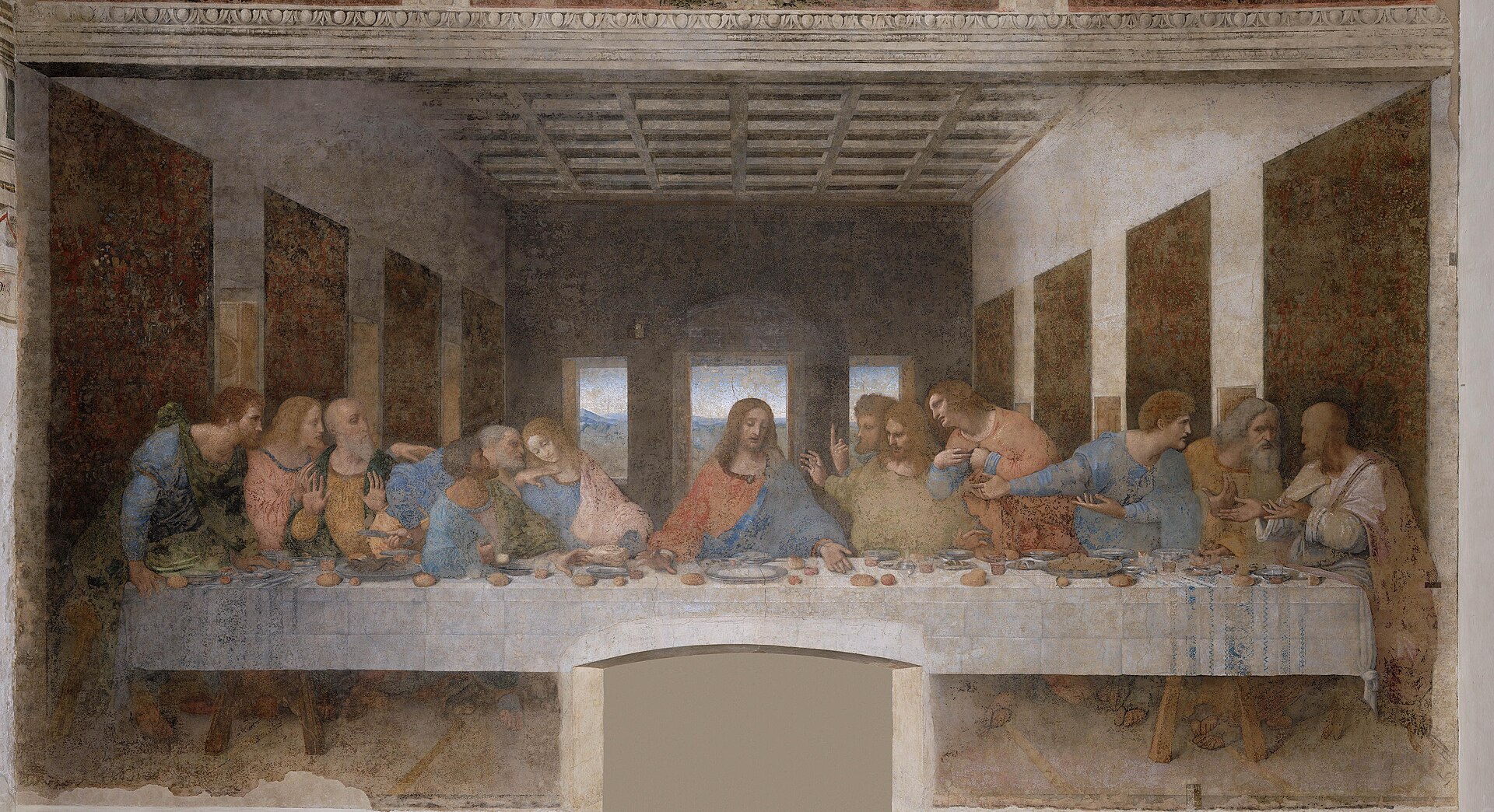
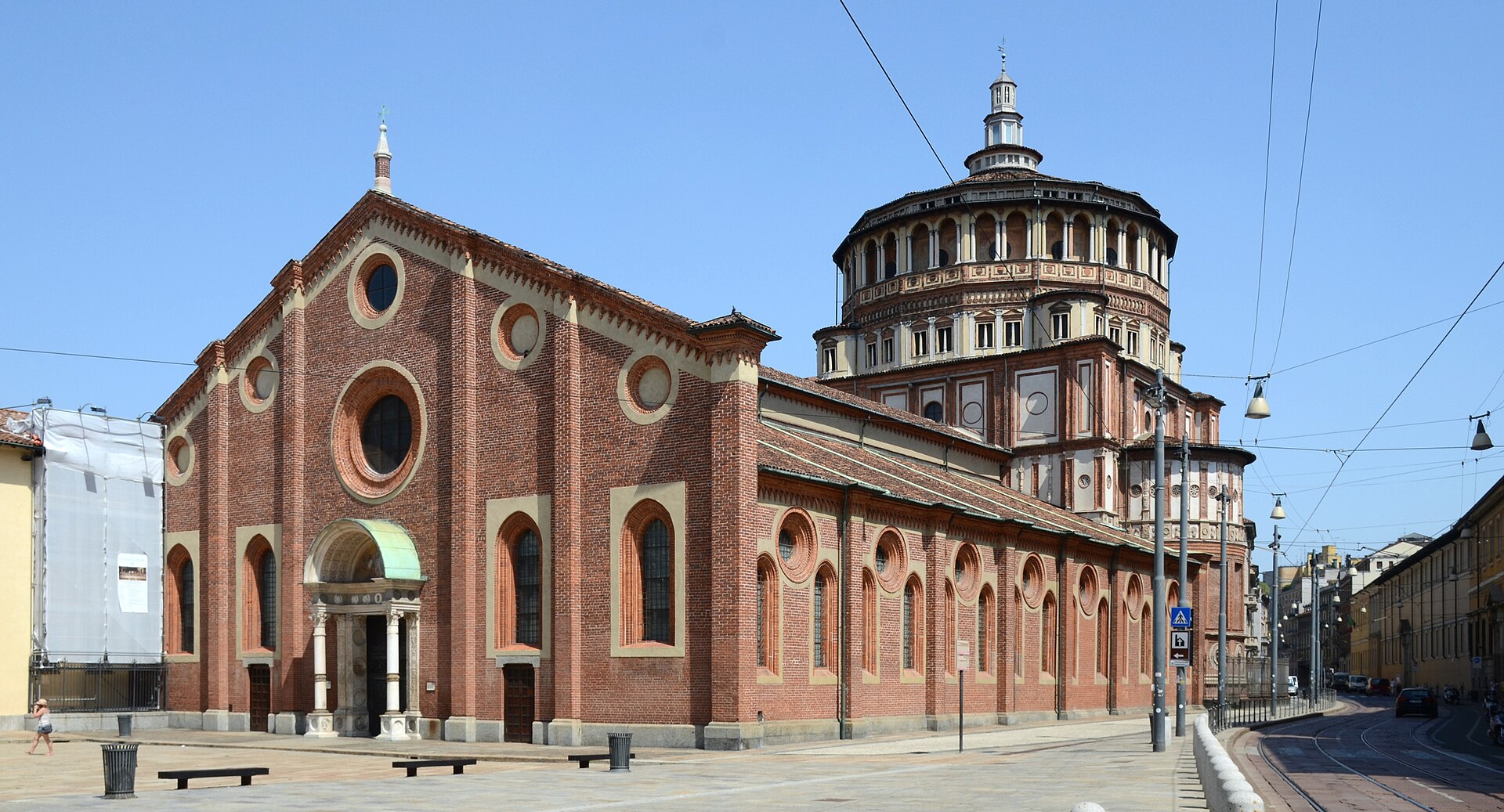
Leonardo da Vinci began flaking off his own wall before the paint was fully dry. He painted The Last Supper, a canvas-sized 4.6 by 8.8 metres, on the end wall of the refectory at Santa Maria delle Grazie in Milan between roughly 1495 and 1498, working for the Dominican friars and their patron, Duke Ludovico Sforza, who wanted his court painter’s greatest work visible to the monks over every meal. Within twenty years of its completion, visitors were already reporting damage to the surface. By the twentieth century, restorers and historians had come to treat the painting less as a fresco to be cleaned than as a patient to be kept alive.
The most recent and most consequential intervention ran from 1978 to 1999, twenty-one years under the direction of the restorer Pinin Brambilla Barcilon. It removed roughly five centuries of overpainting, dirt and failed earlier repairs, working millimetre by millimetre with scalpels and microscopes to find whatever remained of Leonardo’s own hand underneath. What it found was not much, and what it revealed on completion divided critics sharply.
The mural today looks pale and patchy compared with the vivid, high-contrast image reproduced on postcards and textbooks for a century before the restoration. That earlier image was largely the work of eighteenth- and nineteenth-century restorers repainting over Leonardo’s ruined original. Brambilla Barcilon’s team took that repainting off.
An experiment that started failing at once
Leonardo did not paint The Last Supper as a true fresco, in which pigment is applied to wet plaster and bonds with it chemically as it dries. He wanted the slow, layered working method he used on panel paintings, building up glazes and reworking details over days rather than the hours a fresco’s wet plaster allows. So he prepared the wall with a ground of gesso, pitch and mastic, closer to a panel’s surface than a wall’s, and painted on top of it in tempera and oil once it had dried.
The wall would not hold the paint. Damp rising from the refectory’s kitchen on the other side, combined with a ground that was never designed to bond with masonry the way fresh plaster does, meant flaking began within Leonardo’s lifetime. The Italian cleric Antonio de Beatis, visiting the refectory in 1517, recorded in his travel diary that the painting had already begun to deteriorate, less than twenty years after Leonardo finished it. Giorgio Vasari, seeing it decades later, described the surface as an “indistinct smudge”.
Two centuries of well-meant damage
Restorers reached for the painting repeatedly from the eighteenth century onward, each attempt adding a new layer of alteration rather than removing the last. Michelangelo Bellotti retouched it with oil paint in 1726, filling losses and, by some accounts, applying varnish that further darkened the surface. Giuseppe Mazza scraped away parts of the existing paint and repainted several heads in the 1770s, work considered so damaging that the friars stopped him partway through. In 1821 the restorer Stefano Barezzi, experienced in detaching whole frescoes from walls for transfer elsewhere, attempted to lift sections of the painting under the mistaken belief it was a true fresco, and damaged it further before recognising his error and gluing the loosened flakes back down.
The building itself added to the damage. In 1652 the friars cut a taller doorway through the wall to reach an adjoining room, sawing straight through the lower part of the composition and removing Christ’s feet entirely; the doorway was later bricked up, but its irregular, arch-shaped outline is still visible at the base of the painting today. When Napoleon’s revolutionary troops occupied Milan in 1796, they requisitioned the refectory as a stable and armoury, and soldiers reportedly climbed ladders to scratch at the apostles’ faces and threw objects at the wall for sport.
What twenty-one years of work took away
Brambilla Barcilon’s team catalogued eight distinct layers of overpaint accumulated since 1726 and removed them, using solvents and mechanical cleaning to expose whatever original material survived beneath. Her own estimate, published with the art historian Pietro Marani, was that barely half of the visible surface consisted of paint Leonardo himself had applied; the remainder was later restorers’ work or bare, filled loss. Cleaning also uncovered details invisible for centuries: gold leaf on the fold of Judas’s collar, a millefleurs pattern woven into the tablecloth and curtains, and a distant landscape glimpsed through the windows behind Christ. Incised lines scored into the plaster, where Leonardo had marked out the perspective of the coffered ceiling and the table before painting over them, also came to light, evidence of how carefully he had planned a composition he then executed in a technique unsuited to lasting on a wall.
The result, unveiled in 1999, prompted a wave of disappointed commentary. Critics compared photographs of the freshly restored wall with the dramatic, dark-toned image generations had grown up with and found the new version washed out and fragmentary. The Art Newspaper summed up the trade-off in the headline over its own report: a wreck, but at least an authentic wreck. Some scholars went further, arguing in print that so little of Leonardo’s paint survived that what visitors now see is closer to a ruin annotated by conservators than a picture. Brambilla Barcilon’s defenders countered that the alternative, leaving centuries of other painters’ additions in place under Leonardo’s name, was a worse kind of dishonesty, and that the restoration at least let scholars study what technique and materials Leonardo himself had actually used, rather than what Bellotti and Mazza had guessed at.
A wall that nearly did not survive the war
On the night of 15 August 1943, Allied bombing hit the monastery complex directly, bringing down the refectory’s roof and one of its side walls. The wall carrying The Last Supper stood, protected by sandbags and scaffolding that had been placed around it as a precaution years earlier, though for a time it was exposed to the open sky under a temporary tarpaulin before the building could be made secure again. Had the protective works not been in place before the raid, the painting’s already fragile surface would almost certainly not have survived intact.
Fifteen minutes, forty people, one door
Conservation now dictates how the painting is seen as much as how it was cleaned. The refectory operates a sealed, climate-controlled environment, and visitors are admitted in timed groups of up to forty people who pass through air-filtering anterooms before entering. Each group gets fifteen minutes in front of the painting, a limit enforced strictly by museum staff, before the room is cleared for the next booking. Tickets must be reserved well ahead of a visit, often weeks in advance in high season, through the Museo del Cenacolo Vinciano, the institution now responsible for the site.
Lead image: Leonardo da Vinci, The Last Supper, c. 1495–1498. Santa Maria delle Grazie, Milan.