Titian was in his late twenties, still building a reputation, when the Franciscan friars of Santa Maria dei Frari in Venice gave him the commission that would make him famous across Italy: a single altarpiece nearly seven metres tall, to stand behind the high altar of one of the city’s largest churches. He worked on it between 1516 and 1518, painting on a support built from multiple planks of poplar joined edge to edge, since no single panel came close to the size the commission demanded, a scale that meant working from scaffolding inside his own studio simply to reach the top and bottom of the composition.
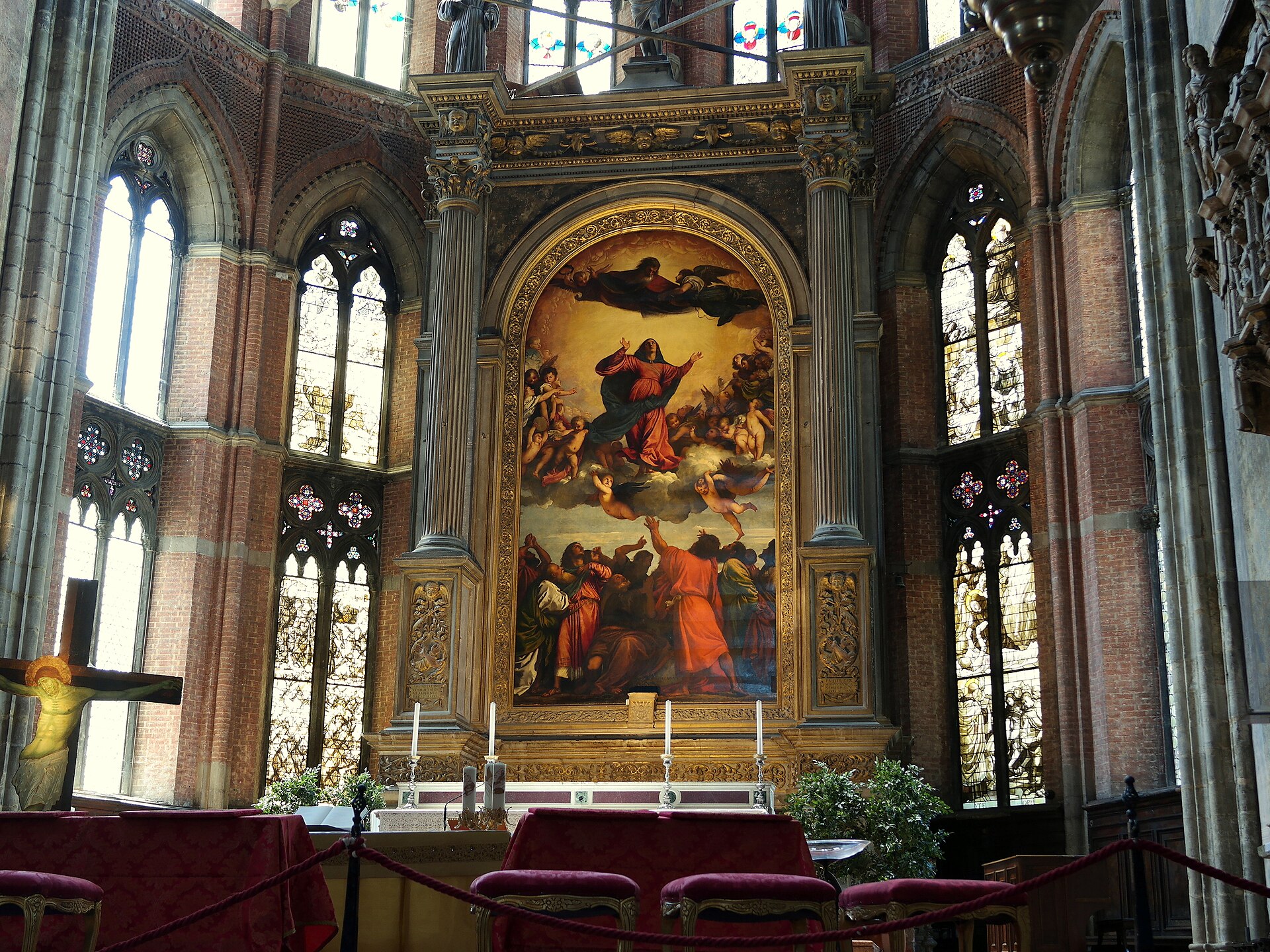
The Assumption of the Virgin, known in Venice simply as the Assunta, shows Mary rising bodily into heaven in a swirl of red and gold drapery, watched from below by a crowd of astonished, gesturing apostles and received above by God the Father, with a ring of cherubs bridging the two zones in a haze of golden light. Unveiled on 19 May 1518, it was, by contemporary account, unlike anything Venetian church painting had produced before: a composition built on motion and saturated colour rather than the calm, static devotional images the city’s altarpieces usually offered.
That departure did not win over everyone straight away. According to an account later recorded by the writer Lodovico Dolce, the painting was initially criticised by less sophisticated viewers and, by some tellings, by the friars themselves, uneasy at apostles who gestured and craned their necks rather than standing in quiet reverence. The doubts did not last. Within a few years the Assunta had established Titian as the leading painter in Venice, a position he held for the rest of his life.
A picture built in three storeys
The composition works as three connected zones stacked one above another, divided from each other by light rather than by any painted architecture or frame. At the bottom, the apostles crowd around the empty tomb, their arms flung upward in astonishment, their robes picked out in the ordinary daylight of the church itself. In the middle register the Virgin rises on a bank of cloud and cherubim, caught between earthly and divine light. At the top, God the Father, attended by two flying angels, reaches down out of a golden radiance to receive her. A visitor standing at the far end of the church’s long nave, one of the largest in Venice, was still meant to read the whole structure clearly, which is part of why Titian built the picture from broad zones of saturated colour rather than fine, close-worked detail.
A wall of colour against Florentine line
The painting sits at the centre of one of the Renaissance’s defining arguments about what painting was for. Florentine theory, given its fullest voice by Giorgio Vasari, held that disegno, drawing and the underlying structural design of a composition, was the discipline’s true foundation, with colour a secondary embellishment applied on top of a form already resolved on paper. Venetian painters, Titian foremost among them, worked the opposite way, building a composition directly on the canvas in layered patches of colour, without extensive preparatory drawing, letting form emerge from the relationships between adjacent tones rather than from an outline. Dolce, defending Titian in print against the Tuscan camp, argued that this colorito achieved a naturalism disegno alone could never reach, and went so far as to rank Titian above Vasari’s own hero, Michelangelo. The Assunta, with its unbroken sweep of red, blue and gold and its almost complete absence of hard contour, is often treated as the clearest possible demonstration of the Venetian position. It is worth remembering that the argument was never purely aesthetic: Florence and Venice were rival centres of patronage and printing as well as painting, and each city’s writers had every reason to talk up their own school’s masters at the other’s expense.
A century in exile at the Accademia
The painting stayed above the Frari’s high altar for nearly three hundred years before Napoleonic suppression of the city’s religious houses swept it, along with a great deal of other Venetian church property, into secular hands. In 1817 it was moved to the Gallerie dell’Accademia, Venice’s newly formed public picture gallery, where curators reportedly had to raise a ceiling to accommodate its height. It remained there, reproduced and studied as a gallery masterpiece rather than encountered as a devotional image, for more than a century, seen by generations of visitors and artists in a setting entirely different from the church interior Titian had designed it for. The painting only returned to the Frari in 1919, in the aftermath of the First World War, when it was reinstalled above the altar it had been painted for, restoring the relationship between picture and building that had shaped its composition in the first place.
What conservators found under the grime
Centuries above a lit altar took a visible toll: candle soot and old varnish had darkened the picture, and by the early twenty-first century conservators identified lifting and flaking paint serious enough to warrant intervention, compounded by vibration from an organ installed directly behind the panel. The Venice-based charity Save Venice funded a study and conservation campaign that ran from 2018 to 2022, following on from an earlier diagnostic and maintenance campaign in 2012 that had first flagged the extent of the lifting paint. Conservators removed the organ, cleaned centuries of grime and discoloured varnish, and stabilised the paint surface and its wooden support, work that also clarified the painting’s spatial construction, revealing the Virgin’s forward-stepping pose and the apostles’ circular grouping around the tomb more clearly than they had appeared in generations of darkened varnish. The restored altarpiece, together with its carved stone frame, was unveiled to the public on 4 October 2022, timed to coincide with the feast day of Saint Francis.
Back where it was painted to be seen
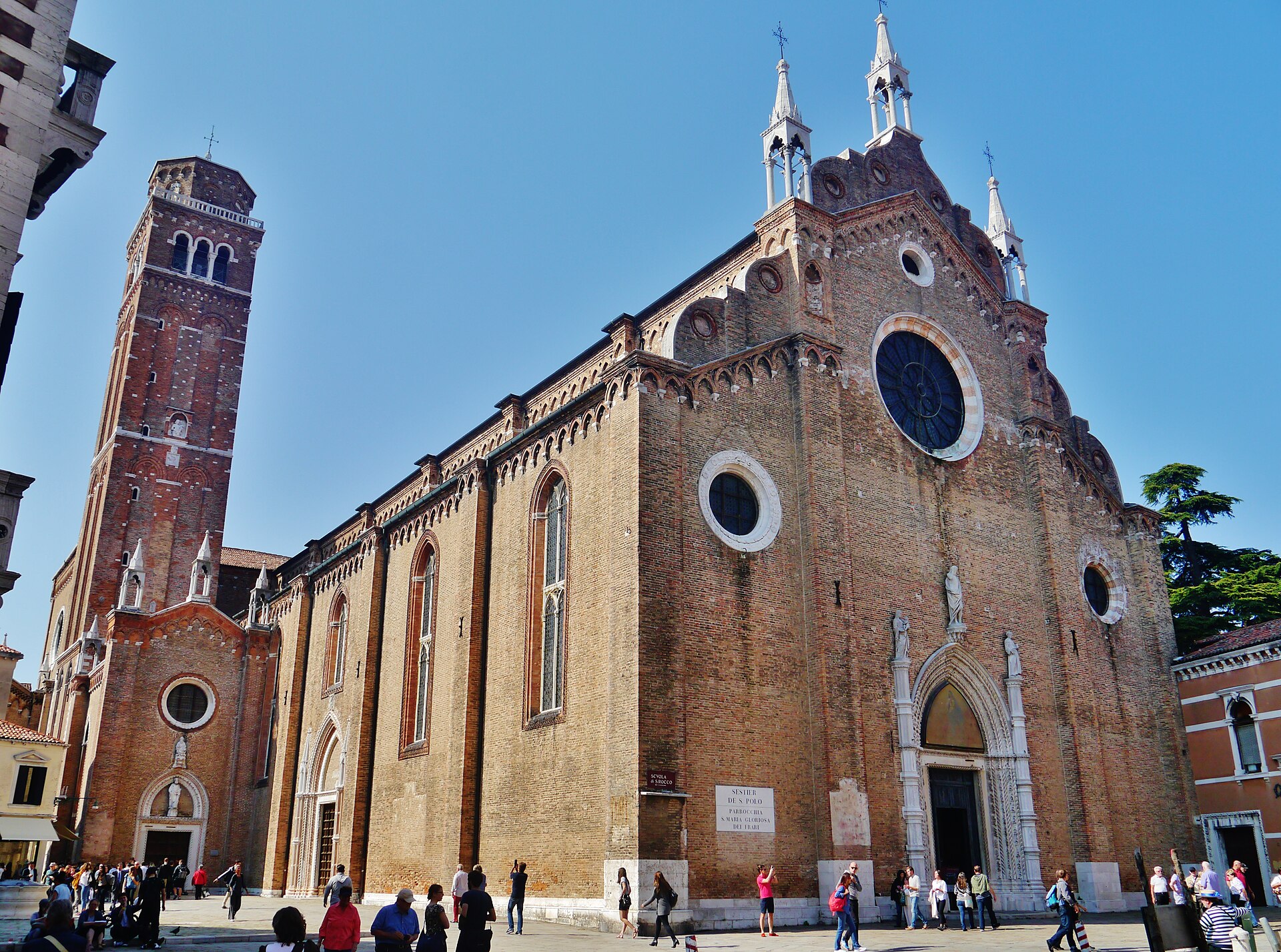
The Assunta now hangs, as it did in 1518, above the high altar of the Frari, framed by the church’s own soaring gothic choir screen, still one of the largest altarpieces on view anywhere in Italy. The Basilica dei Frari is open to visitors daily, with a modest entrance fee, and the painting remains the first thing a visitor’s eye is drawn to on entering the nave, exactly the effect Titian is thought to have calculated when he built the composition to be legible from the church’s full length. Titian himself is buried in the same church, in a nineteenth-century monument facing the nave, not far from the altarpiece he painted as a young man and which, by the time of his death in 1576, had already been in place for nearly six decades.
Lead image: Titian, Assumption of the Virgin, 1516–1518. Basilica dei Frari, Venice.