A young surveyor cycles out from a drawing office in Modena with a folding measuring rod strapped to his bicycle. It is the early 1970s, and Luigi Ghirri spends his working days plotting boundaries and elevations as a licensed geometra, the Italian term for a technical surveyor. On weekends and evenings he photographs car parks, allotments, funfairs and the painted advertisements on the sides of buildings, subjects no one else considered worth a frame. Within a decade he would be recognised as the photographer who changed how Italy pictured itself.
Ghirri was born on 5 January 1943 in Scandiano, in the flat farming country between Modena and Reggio Emilia. He did not attend art school or a photography course; his training was in measurement, in reading the land as a set of coordinates. That background shows in the finished work: horizons sit dead level, verticals are true, and colour is handled with the flat, even light of a technical drawing rather than the drama of reportage. He kept the day job into the mid-1970s before photography became his sole occupation.
His first mature series, made across the second half of that decade, asked a deceptively simple question: what happens when the camera photographs an image rather than a scene. A postcard rack, a painted road sign, a poster peeling off a wall, a photograph pinned inside a shop window, all became his subject matter as readily as a field or a piazza.
A world already full of pictures
The project that made this argument explicit was Kodachrome, a body of work begun around 1970 and published as a self-produced book in 1978. Its title names the Kodak colour slide film Ghirri used throughout, prized for its saturated, slightly artificial palette. The pictures show billboards, shop signs, toy globes and postcards of Italian monuments, framed so that the boundary between the real object and its printed or painted copy becomes difficult to find.
The pictures deliberately avoid drama: a painted sunset on a beach-hut wall, a road sign pointing towards a monument rather than the monument itself, a photograph of the sea propped in a shop window next to the real coastline outside. Ghirri’s point was not playful confusion for its own sake. He was arguing that the modern landscape already arrived pre-photographed, pre-advertised and pre-packaged in reproductions long before any camera was raised to it, so a photograph that copied a photograph was no less honest than one that copied a field. He described his method as playing different systems of signs against one another: the sign for a tree against an actual tree, a painted sea against the sea itself. In doing so he set his own course apart from Italy’s long tradition of dramatic reportage photography.
Twenty photographers and a new map of Italy
By the early 1980s Ghirri was drawing together photographers who shared his interest in the ordinary and the overlooked. With fellow curators Gianni Leone and Enzo Velati he assembled Viaggio in Italia (Journey to Italy), a touring exhibition and book that opened in 1984 and brought together roughly twenty Italian photographers working away from the picturesque monuments and folkloric peasants that had defined tourist photography of Italy for a century. The book showed petrol stations, motorway verges, suburban gardens and provincial squares, printed without embellishment, deliberately excluding the gondolas, hill towns and ruins that filled travel posters of the period.
The title borrowed from a much older tradition, the Grand Tour accounts written by northern European visitors discovering Italy for the first time, and turned it inward: this was Italians looking freshly at their own overlooked country rather than foreigners marvelling at its monuments.
The project became, in the words later used to describe it, an unofficial manifesto of the new Italian landscape school. It gave a generation of photographers a shared vocabulary and a shared refusal of spectacle. Ghirri’s own intellectual partnership with the writer and film-maker Gianni Celati, a close friend from the same years, ran alongside this work; Celati went on to direct the 1999 documentary Il mondo di Luigi Ghirri (The World of Luigi Ghirri), and the pairing of photographer and writer has since been the subject of dedicated museum exhibitions in its own right.
Inside Morandi’s studio
In 1989 and 1990, close to the end of his life, Ghirri turned his camera on a single interior: the studio of the painter Giorgio Morandi at Via Fondazza in Bologna, left largely untouched since Morandi’s death in 1964. Ghirri photographed the bottles, boxes and jars the painter had arranged and rearranged for decades, along with the dust, the worn brushes and the particular grey light of the room. The series reads as a quiet dialogue between two artists who shared an interest in restraint, repetition and the poetry of ordinary objects, rather than as documentation of a shrine.
Death at forty-nine and an archive at Roncocesi
Ghirri died of a heart attack on 14 February 1992 at his home in Roncocesi, near Reggio Emilia, at the age of forty-nine. He had been working until days before his death. His family established the Archivio Ghirri at Roncocesi to preserve his negatives, prints and working notebooks, and a substantial body of his prints and composite works, 670 pieces in total, is held by the Centro Studi e Archivio della Comunicazione (CSAC) at the University of Parma, which catalogues Italian visual culture of the twentieth century.
A photographer rediscovered
Ghirri’s international standing has grown substantially since 2013, when the MAXXI museum in Rome mounted the retrospective Luigi Ghirri: Pensare per Immagini (Thinking in Images). A further touring retrospective, The Map and the Territory, opened at the Museo Reina Sofía in Madrid before travelling to other European venues in 2018 and 2019, introducing his work to audiences who had known it only through reproduction — an irony he would likely have appreciated. In 2024 the museums of Lugano staged Luigi Ghirri: Viaggi 1970–1991, drawing on four decades of his journeys around Italy and Europe.
The publisher MACK now keeps several of his books in print, including a reissue of Kodachrome itself, alongside a volume collecting his critical writing. Younger photographers working with colour, the domestic and the deliberately unspectacular continue to be read against his example, and the CSAC archive in Parma remains open to researchers who want to see, rather than simply read about, the negatives that started the argument.
The house at Roncocesi where Ghirri lived and died still stands in the flat Emilian countryside he spent thirty years photographing, a short drive from the Modena surveying offices where his career in images began by accident.
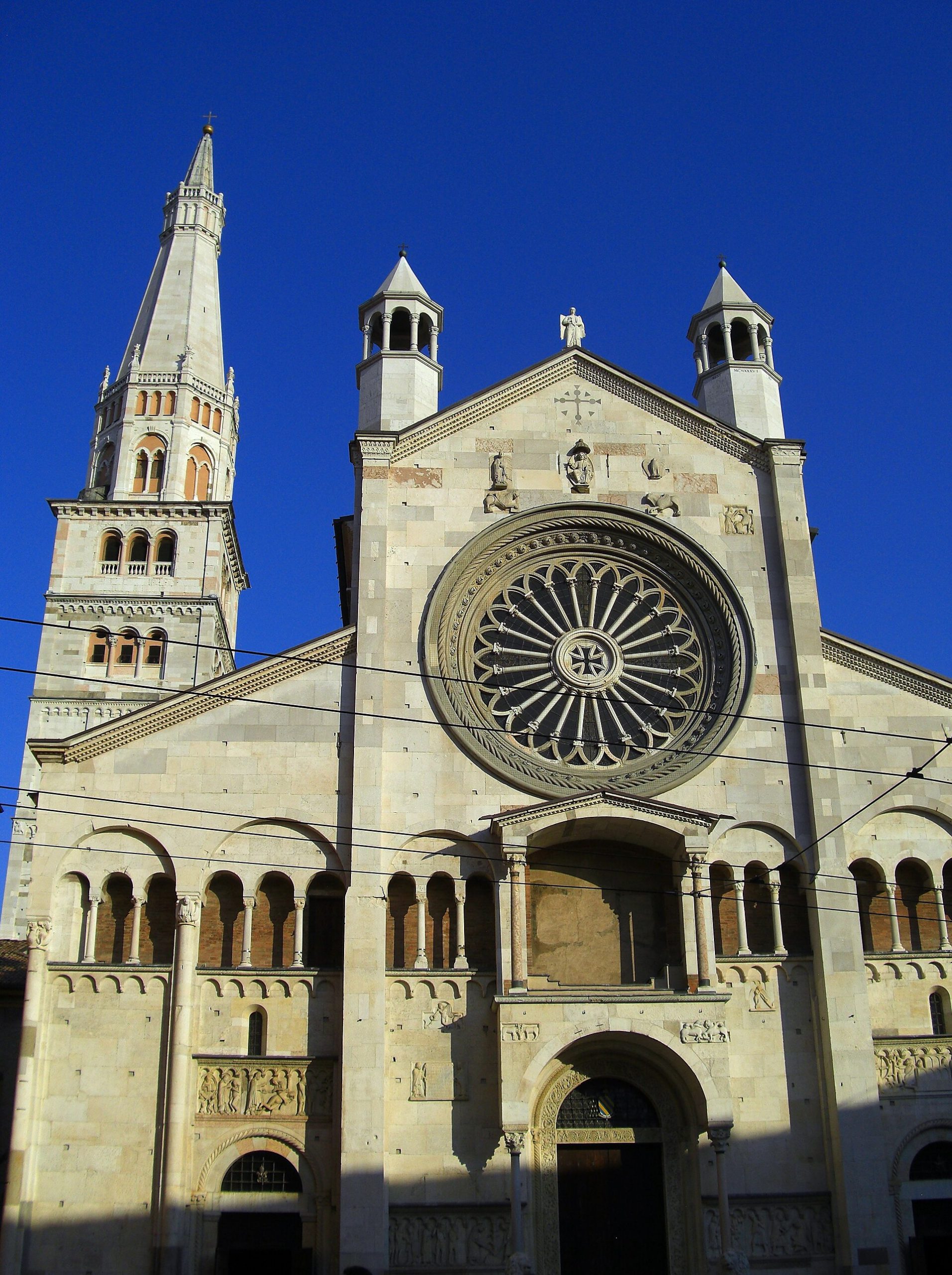
Lead image: Modena, where Ghirri worked as a surveyor before turning to photography. Photo: CC BY-SA via Wikimedia Commons.