Renzo Piano was born in Genoa on 14 September 1937 into a family already in the building trade. His grandfather had founded a masonry business; his father Carlo expanded it after the Second World War into Fratelli Piano, a construction firm that built houses and factories and sold materials around the port city. Piano has said the building site was effectively his childhood classroom, and he trained formally as an architect in Florence and Milan before setting up his own practice, but the instinct that a building is, first, a thing to be physically constructed rather than drawn never left his later work, however far it took him from Liguria. He returned to his home city repeatedly across his career, most notably to redevelop the old port, the Porto Antico, for Expo 1992, the international celebrations marking the 500th anniversary of Christopher Columbus’s voyage. The redevelopment’s centrepiece was the Genoa Aquarium, a building some liken to a ship about to leave harbour, which Piano designed and which opened to the public in October 1993 on a waterfront the city had let decay through much of the twentieth century.
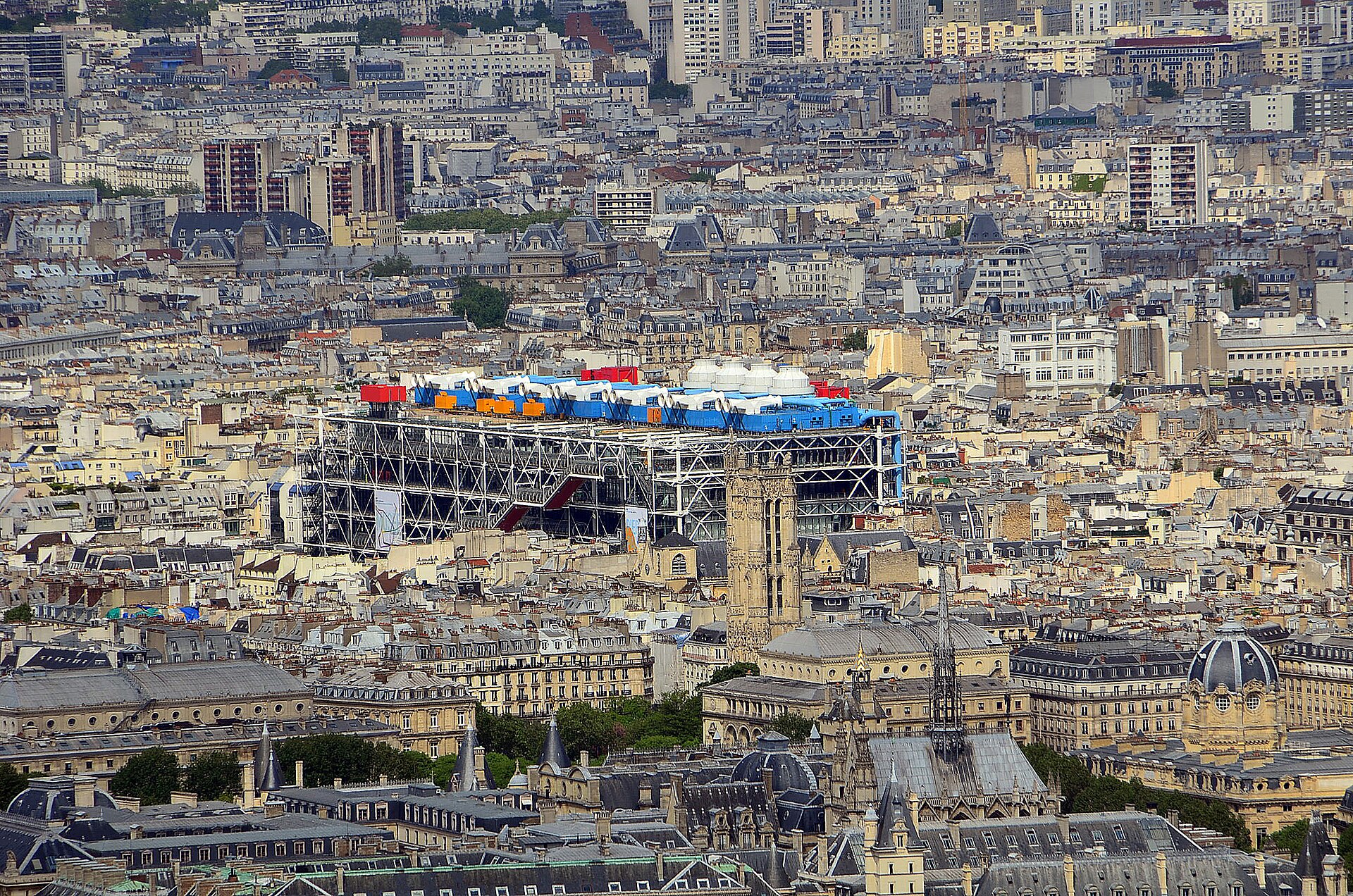
It took him, at 33, to Paris. In 1971 Piano and the British architect Richard Rogers, then both largely unknown outside their own circles, won an international competition to design a new cultural centre near Les Halles in the city centre, beating more than 680 other entries with a scheme that put the building’s structure, escalators and mechanical services on the outside of the facade, leaving the interior as open, uninterrupted floor space. The Centre Georges Pompidou opened in 1977 to controversy — critics likened its exposed ducts and brightly coloured pipework to an oil refinery — and then to enormous public success, drawing millions of visitors a year and establishing both architects’ careers at once.
A practice built one commission at a time
Piano’s work after Pompidou avoided repeating its formula. The Menil Collection in Houston, designed between 1982 and 1987 for the art collectors John and Dominique de Menil, is a low, quiet building organised around a system of curved ferro-cement roof louvres that filter and diffuse Texas daylight onto the art below without any electric lighting during the day, a technical solution as considered as Pompidou’s exposed structure but pursued toward the opposite effect: near invisibility rather than spectacle. Kansai International Airport, built on an artificial island in Osaka Bay and opened in September 1994, gave Piano a single terminal building 1.7 kilometres long, its roof profile calculated to guide air currents through the interior without mechanical assistance and its structure built with sliding joints to absorb ground movement, a precaution vindicated in January 1995 when the Great Hanshin earthquake struck some 20 kilometres away and the terminal came through essentially unscathed. In London, the Shard, completed in 2012 as the tallest building in the United Kingdom and, briefly, in western Europe, at 309.6 metres, gave the skyline a tapering glass spire that Piano based on the masts of ships in the Thames and the spires of London church towers, deliberately avoiding a flat roofline.
14 August 2018
None of it prepared Genoa for what happened on its own waterfront on 14 August 2018. A section of the Ponte Morandi, a motorway viaduct designed by the engineer Riccardo Morandi and opened in 1967, collapsed during a rainstorm, sending a roughly 200-metre stretch of roadway, vehicles and their occupants 45 metres down onto a riverbed, a rail line and factory buildings below. Forty-three people died. The bridge had carried a critical stretch of the A10 motorway linking Genoa to France, and its collapse cut the city in two, forcing residents in the working-class neighbourhoods beneath it to find new routes to reach the rest of their own city while investigators, and later prosecutors, examined years of documented corrosion and inadequate maintenance. Dozens of people connected to the motorway operator Autostrade per l’Italia and to government ministries responsible for oversight went on trial over the disaster in the years that followed, a process still working through Italy’s courts well after the replacement bridge itself had opened to traffic.
A design given away
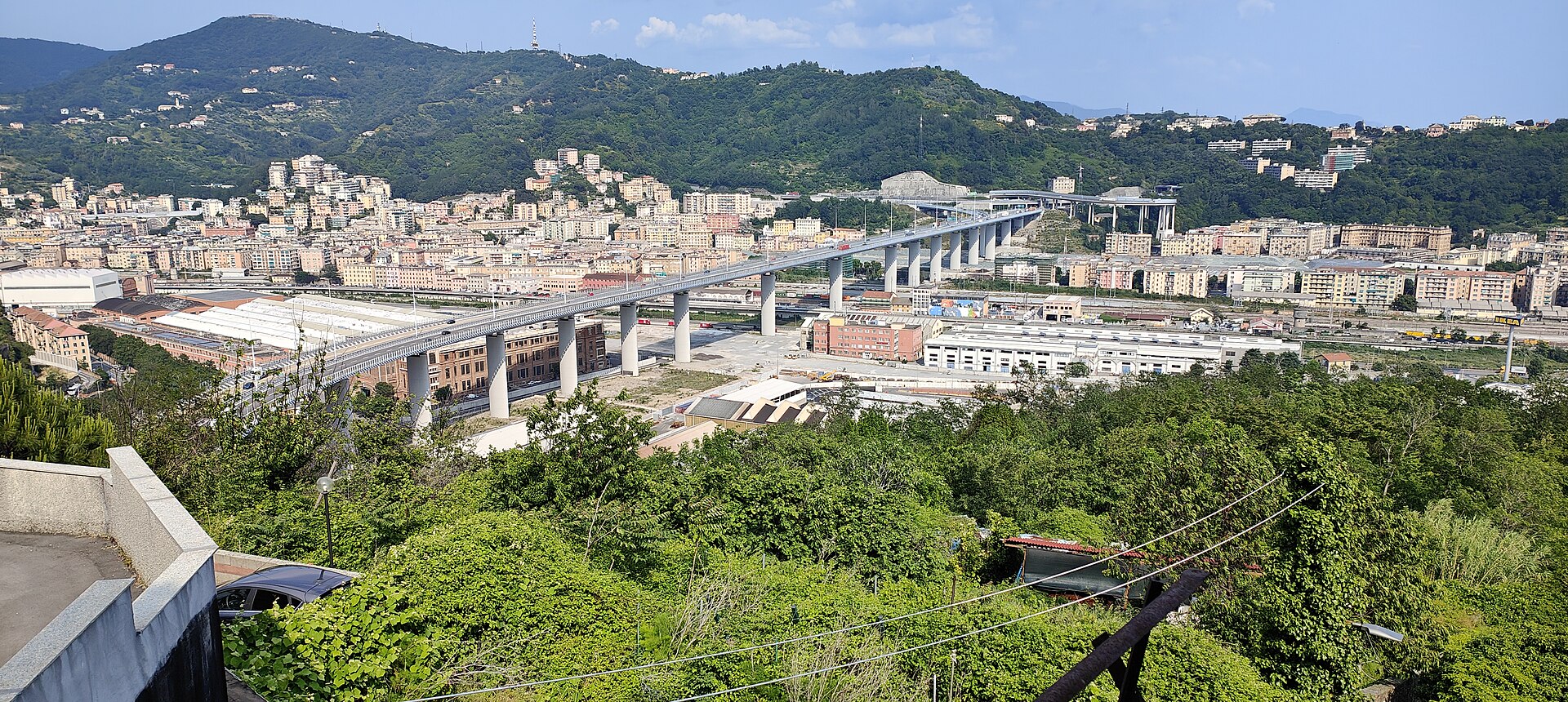
Piano, a Genoese by birth who still keeps a home in the city, offered his services for the replacement without charge. His scheme, developed with the engineering firms Arup and Italferr among others, replaced Morandi’s cable-stayed spans with a low, steel-decked bridge carried on 18 slender elliptical concrete piers, its underside shaped to recall the curve of a ship’s hull, a reference to Genoa’s maritime identity that Piano has returned to repeatedly across his career. The Genova San Giorgio bridge, 1,067 metres long, was built in just over a year under an emergency legal framework that bypassed Italy’s usual lengthy public-works procedures, and was inaugurated on 3 August 2020, less than two years after the collapse. Forty-three lamps, one for each victim, light the bridge’s length at night, and the names of the dead were read aloud at the opening ceremony as ships in the port sounded their horns.
What honours followed
Piano won the Pritzker Prize, architecture’s highest international honour, in 1998, with the jury citation comparing his range and technical curiosity to Michelangelo and Leonardo da Vinci. In August 2013, Italy’s then president Giorgio Napolitano appointed him senator for life, one of a small number of Italians granted the lifetime Senate seat in recognition of exceptional contributions to national life; Piano has used the position chiefly to fund and advise on public infrastructure and urban renewal projects in Italy’s poorer peripheries rather than to align with a political party. He set up a small working group, called G124, of young architects paid from his own senator’s salary and selected afresh each year to study and propose fixes for run-down suburbs in cities including Turin, Milan, Padua, Venice and Rome.
What Genoa sees now
The Genova San Giorgio bridge now carries motorway traffic across the Polcevera valley on the route the Morandi bridge once held, its low steel profile visible from much of the surrounding city and its 43 lights still marking the anniversary of the collapse each August. The Centre Pompidou in Paris, the building that first made Piano’s name alongside Rogers, closed in March 2025 for a renovation not due to finish until 2030, leaving the Genoa bridge, for now, as the most visible working example of Piano’s engineering instincts applied at speed to a genuine emergency.
Lead image: Renzo Piano, Genova San Giorgio bridge, inaugurated 3 August 2020. Genoa.