On 15 January 1928, a 36-year-old architect named Gio Ponti published the first issue of a magazine he had founded and would go on to edit, in two long stretches separated by a wartime interruption, for roughly four decades. Domus was conceived as a record of “the architecture and decor of the modern home in the city and in the country,” and under Ponti it became the most influential design magazine to come out of Italy, tracking and often shaping the country’s post-war reinvention of furniture, ceramics, glass and building design. Ponti directed it from 1928 to 1941, returned in 1948 after a spell running a rival title, and stayed at its helm until 1976, three years before his death.
Ponti was never only an editor. Trained as an architect in Milan and graduating in 1921 after service in the First World War, he designed ceramics for the porcelain maker Richard-Ginori through the 1920s, then furniture, glassware, cutlery, church interiors and more than 100 buildings over a career spanning half a century, moving fluently between decorative arts and structural engineering in a way few of his Italian contemporaries attempted. Ponti’s wartime break from Domus came in 1941, when he left to found and edit a rival monthly, Stile, returning to his own magazine only in 1948 once Stile had folded; across both stretches, colleagues at the magazine later recalled a man who wrote most of the unsigned editorial commentary himself and treated the printed page with the same attention to proportion he brought to a building’s facade.
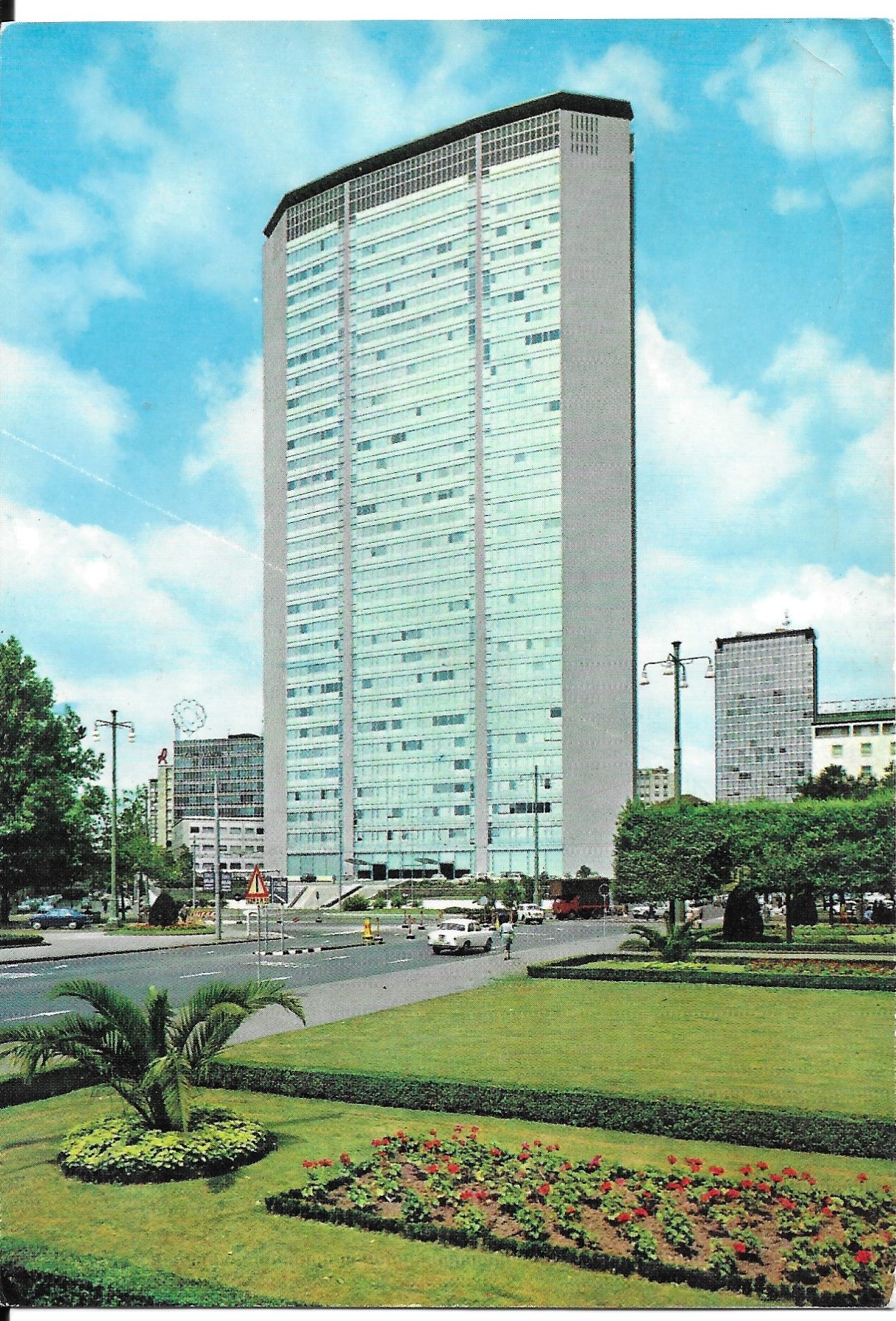
The building most identified with him today rises above the Milan skyline a short walk from the city’s main railway station, chosen by the tyre manufacturer Pirelli as the site for a new corporate headquarters that would announce, in a single silhouette, the confidence of Italy’s post-war industrial recovery.
A tower too thin to be a slab
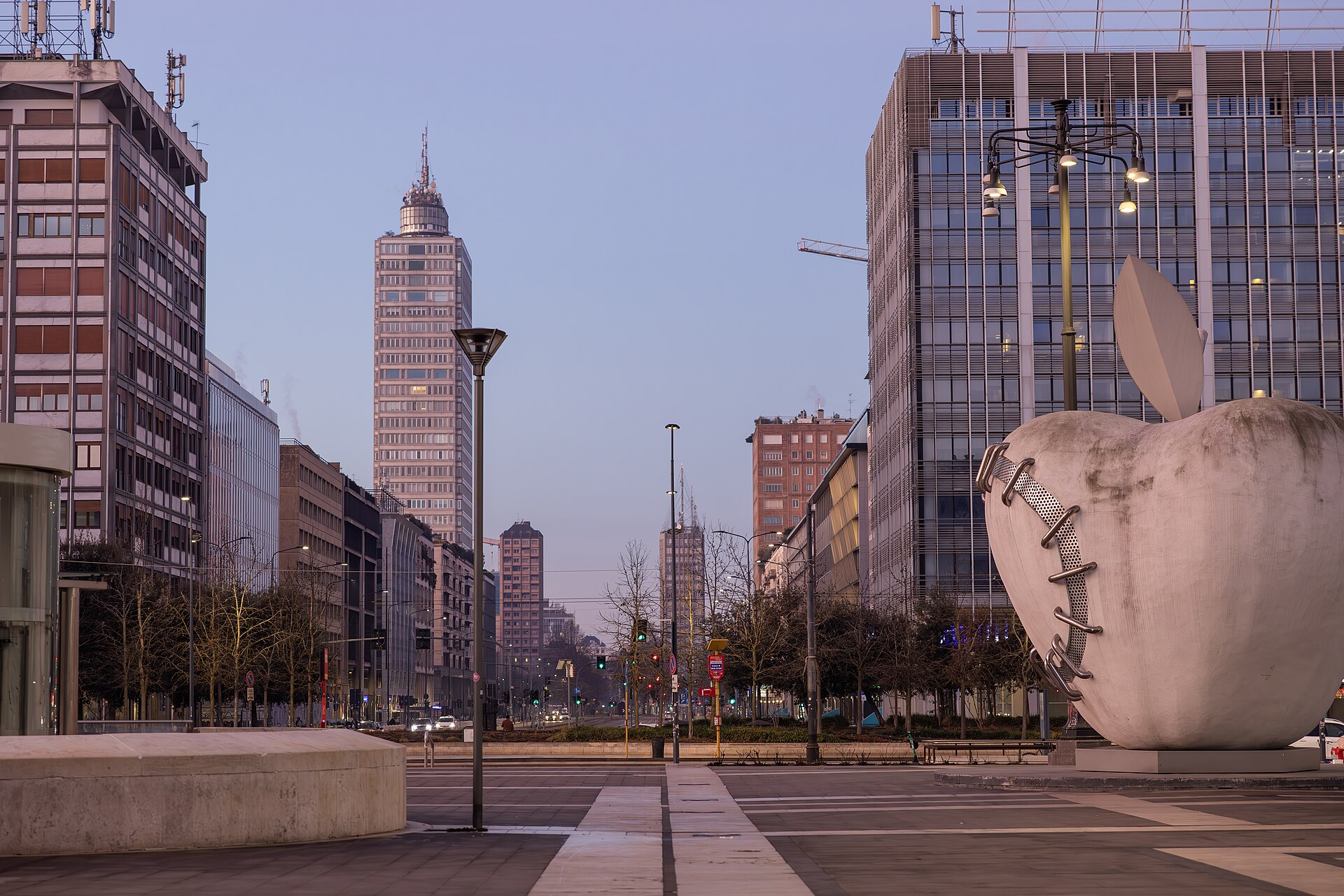
The Pirelli Tower, headquarters of the tyre manufacturer Pirelli, was designed by Ponti’s studio and built between 1956 and 1960 on a narrow, pentagonal plot at Piazza Duca d’Aosta. Rather than the rectangular slab typical of American office towers of the period, Ponti gave the building a lens-shaped plan that tapers to blunt points at each end, just 20.5 metres wide at its broadest and 75.5 metres long, so that from the front it reads as a knife-edge and from the side as a solid block. At 127 metres to the roofline, it was briefly the tallest reinforced-concrete building in Europe on completion.
Ponti could not have built it without Pier Luigi Nervi, the structural engineer whose calculations, alongside those of Arturo Danusso, made the tapered form stand up. Nervi’s design concentrated the load-bearing structure into four hollow reinforced-concrete piers, two at each pointed end, freeing the long facades from any need for closely spaced columns and letting Ponti glaze them almost edge to edge. Nervi had already built a reputation designing wide-span concrete structures for exhibition halls and aircraft hangars, work that depended on treating reinforced concrete as a material with its own expressive logic rather than a hidden substitute for steel or stone; the Pirelli commission let him apply that logic to a tall building instead of a wide one. The result let architecture and engineering read as a single decision rather than a compromise between them: a building whose slenderness is structural fact, not decorative illusion, and one that dwarfed everything else on the Milan skyline when it opened.
18 April 2002
On the afternoon of 18 April 2002, a small Swiss-registered Rockwell Commander 112 aircraft, flying from Locarno to Milan and low on fuel, struck the tower’s upper floors, killing the pilot and two people working inside the building. The impact tore open a section of the facade and started a fire. The building was restored over the following years, with the damaged floors rebuilt to preserve Ponti’s original design and the structural and artistic character of the tower, which reopened as the seat of Lombardy’s regional council, the institution that had bought the building from Pirelli in 1978.
A chair light enough to lift with one finger
Ponti’s other lasting object from this period weighs 1.7 kilograms. The Superleggera (“super-light”) chair, designed for the furniture maker Cassina and put into production in 1957, reduced a traditional Chiavari-style chair to ash wood legs with a triangular cross-section just 1.8 centimetres to a side, joined to a rush or cane seat with no reinforcement beyond the geometry itself. Ponti reportedly tested prototypes by dropping them from an upper-storey window to prove they would not break, and the chair remains in production with Cassina today, one of the few Italian design objects from the 1950s still made by its original manufacturer to the original specification. Ponti had spent years working toward the design, producing earlier, heavier versions through the 1950s before arriving at the final proportions; the finished chair, numbered 699 in Cassina’s catalogue, is light enough to be lifted and held aloft with a single finger hooked under the top rail, a demonstration Ponti is said to have performed himself.
Late commissions, an ocean apart
In his last decade and a half Ponti worked increasingly outside Italy. He designed the exterior envelope of the Denver Art Museum’s North Building, built between 1970 and 1972 in collaboration with the American firm James Sudler Associates, giving Denver a castellated tower faced in more than a million grey glass tiles that still stands as one of his few completed buildings in the United States. Closer to home, he designed the Concattedrale Gran Madre di Dio in Taranto, built between 1964 and 1970, a stark white rectangular volume topped by a huge pierced concrete screen that locals nicknamed “the sail” for its shape above the Ionian Sea coastline. Both late buildings shared a habit that runs through Ponti’s career: a fascination with thinness and perforation, walls treated less as solid mass than as pierced, patterned skins, whether in the diamond-faceted tiles of Denver or the sail-like screen at Taranto. Ponti died in Milan on 16 September 1979, having submitted a design proposal for the Centre Georges Pompidou competition as late as 1971 and continued designing decorative objects, including a series of silver pieces made with the silversmith Lino Sabattini, almost to the end.
What stands in Milan today
The Pirelli Tower, still commonly called the Pirellone by Milanese, remains the seat of the Lombardy regional government and is not generally open to casual visitors, though it is visible in full from the piazza in front of Milan Centrale station and from the surrounding Porta Nuova district it once dominated alone. The Superleggera chair is on permanent display, among other places, at the Denver Art Museum, in the building whose facade Ponti designed on the opposite side of the world.
Lead image: Gio Ponti and Pier Luigi Nervi, Pirelli Tower, 1956–1960. Milan.