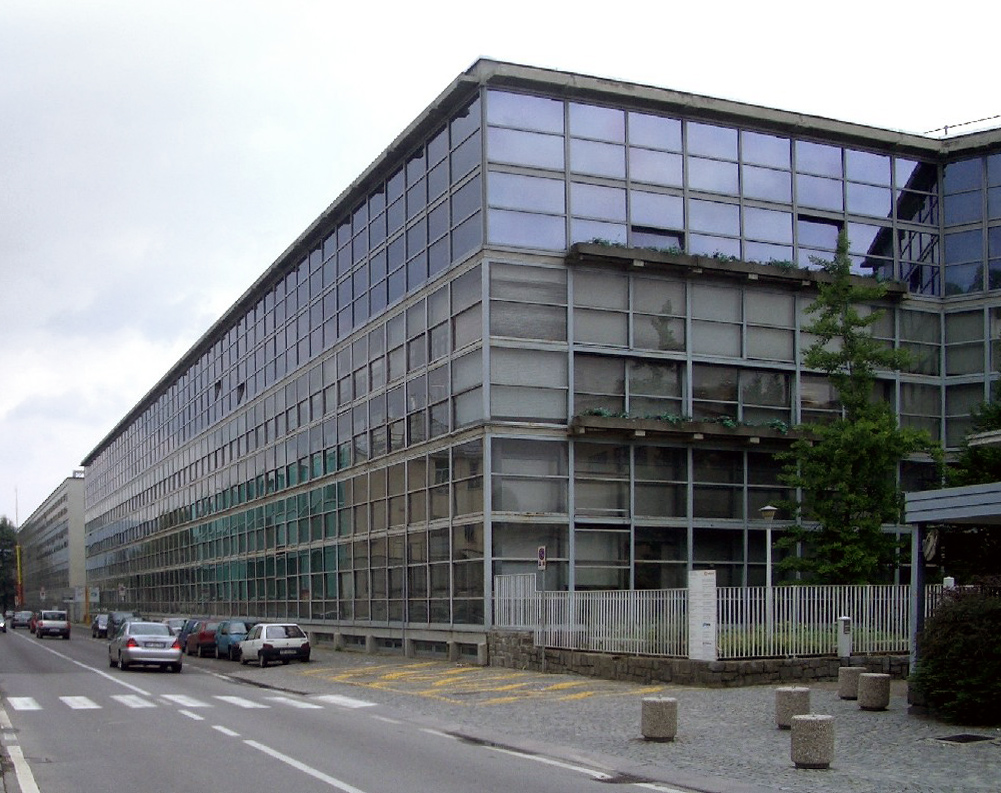
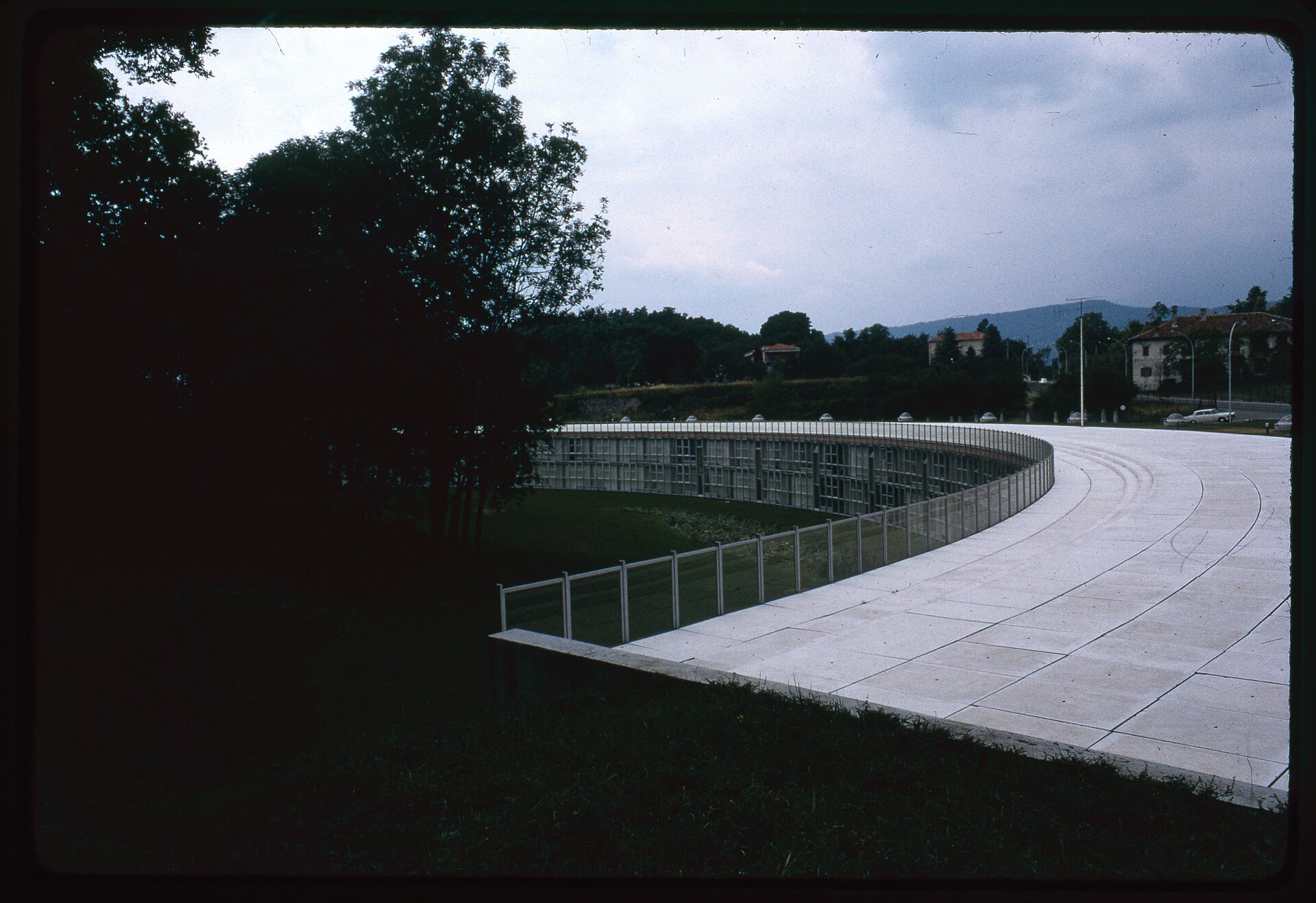
Ivrea sits at the foot of the Alps in Piedmont, a modest town that would likely be unremarkable were it not for a typewriter factory. Camillo Olivetti founded the company there in 1908, but it was his son Adriano who, from the 1930s onward, rebuilt Ivrea around it: factories designed by leading modernist architects, a nursery and canteen for workers, housing estates, a library and social services that went well beyond anything Italian labour law required at the time. Adriano Olivetti believed a factory town could be an instrument of culture as much as production, and in 2018 UNESCO inscribed the result, Ivrea, Industrial City of the 20th Century, as a World Heritage Site, covering 52 hectares of factory buildings, offices and residential units built between the 1930s and 1960s.
What made Olivetti unusual among manufacturers was its insistence that the objects themselves look as considered as the buildings that made them. From the 1930s the company hired outside architects and artists rather than relying only on in-house engineers, and it treated industrial design as a discipline worth paying for at a time when most Italian manufacturers saw a typewriter as plumbing: functional, and nobody’s business how it looked. Adriano Olivetti extended the same conviction into politics, founding a movement, Comunità, that argued for decentralised, culturally engaged industry as an alternative to both unchecked capitalism and state planning; he was elected mayor of Ivrea in 1956 and sat briefly in the Italian parliament, though the company’s design output long outlasted the political project’s reach beyond Piedmont.
A portable machine that fit a briefcase
The clearest early expression of that approach is the Lettera 22, a portable typewriter designed by Marcello Nizzoli and released in 1950. Nizzoli, trained as a painter and architect, gave the machine a compact, rounded aluminium body that weighed little enough to travel and looked, next to the boxy typewriters of the period, almost sculptural. It became standard equipment for journalists and writers across several decades and sits in the permanent design collections of the Museum of Modern Art in New York and the San Francisco Museum of Modern Art, among others, as one of the defining objects of mid-century Italian design.
From typewriters to mainframes
Olivetti’s ambitions outgrew typewriters within a decade. In 1959 the company launched the Elea 9003, Italy’s first commercially produced transistorised mainframe computer, developed under the engineer Mario Tchou. Ettore Sottsass, hired by Adriano Olivetti in 1956 as a design consultant, gave the machine’s cabinets a restrained, modular form organised around the needs of the people operating it rather than the bulk of the electronics inside — low consoles a seated operator could reach across, cabling and heat-generating components moved out of the working area. The Elea 9003 won Sottsass the Compasso d’Oro, Italy’s top industrial design award, in 1959.
Sottsass’s best-known object for Olivetti followed a decade later. The Valentine, a portable typewriter designed with the British-born designer Perry King and released in 1969, came in bright red ABS plastic rather than the greys and creams of conventional office equipment, packaged with a matching carrying case that made it as much a personal accessory as a tool. Sottsass and King conceived it explicitly for use outside the office — on a train, at a kitchen table — positioning it against the idea that a typewriter had to look serious to be taken seriously. The name played on that informality too: Olivetti’s marketing pitched the machine as a plausible Valentine’s Day gift, an object for a student or a young professional rather than a corporate typing pool, and it appears today in the design collections of the Museum of Modern Art and the Victoria and Albert Museum as much for that shift in attitude as for its colour.
The machine some call the first personal computer
Between the Elea and the Valentine came the Programma 101, unveiled in the United States in 1964 and put into commercial production the following year, styled and ergonomically shaped by Mario Bellini and engineered under Pier Giorgio Perotto. Roughly the size of a large typewriter, it combined a keyboard, a built-in printer and a magnetic card reader for storing programs, with an instruction set capable of conditional branching that put it closer to a stored-program computer than to a conventional calculator — the basis for its frequent description today as one of the first desktop computers. Olivetti sold roughly 40,000 units, the great majority in the United States, at a launch price of $3,200; NASA bought around ten of them and used the machine to help calculate lunar module trajectory data during the Apollo 11 mission, running the calculations the module’s own onboard systems could not perform alone.
A radical bookcase, and a group named after a song
Sottsass’s career took a sharper turn after he left Olivetti’s design consultancy. On 11 December 1980, at his apartment in Milan, he convened a group of younger designers and architects to discuss what design might look like once it abandoned the restraint that had defined Italian modernism, including his own work for Olivetti. The result, presented publicly the following year and named Memphis after a Bob Dylan song that had played on repeat during that first meeting, produced furniture and objects in clashing colours, plastic laminates and deliberately ungainly proportions. The group’s best-known piece, Sottsass’s Carlton room divider of 1981, is a freestanding totem of angled shelves and a jagged pediment in wood veneer and coloured laminate that functions poorly as storage and was never meant to function well as anything except an argument against good taste as Italian design had defined it. The first Memphis collection was unveiled on 18 September 1981 at the Arc ’74 showroom in Milan, drawing crowds so large that Sottsass, arriving late and stuck in traffic outside, briefly wondered whether something had gone wrong in the city centre. Memphis stayed active only until 1988, but its clashing colours and patterned plastic laminates shaped record covers, magazine layouts and shopfronts well beyond the furniture world for the rest of the decade.
Sottsass died in Milan on 31 December 2007, at the age of 90, having moved on from Memphis by the mid-1980s to run his own architecture and design practice. Ivrea today still houses the former Olivetti factory and administrative buildings that make up the UNESCO site, several now repurposed for offices, archives and cultural use as the town works to make the listing mean something beyond a plaque, while original Lettera 22s and Valentines, no longer manufactured, remain sought after in the design-collector’s market that Olivetti’s insistence on hiring artists rather than engineers alone helped create.
Lead image: Former Olivetti office building, Ivrea, part of the UNESCO-listed industrial city.