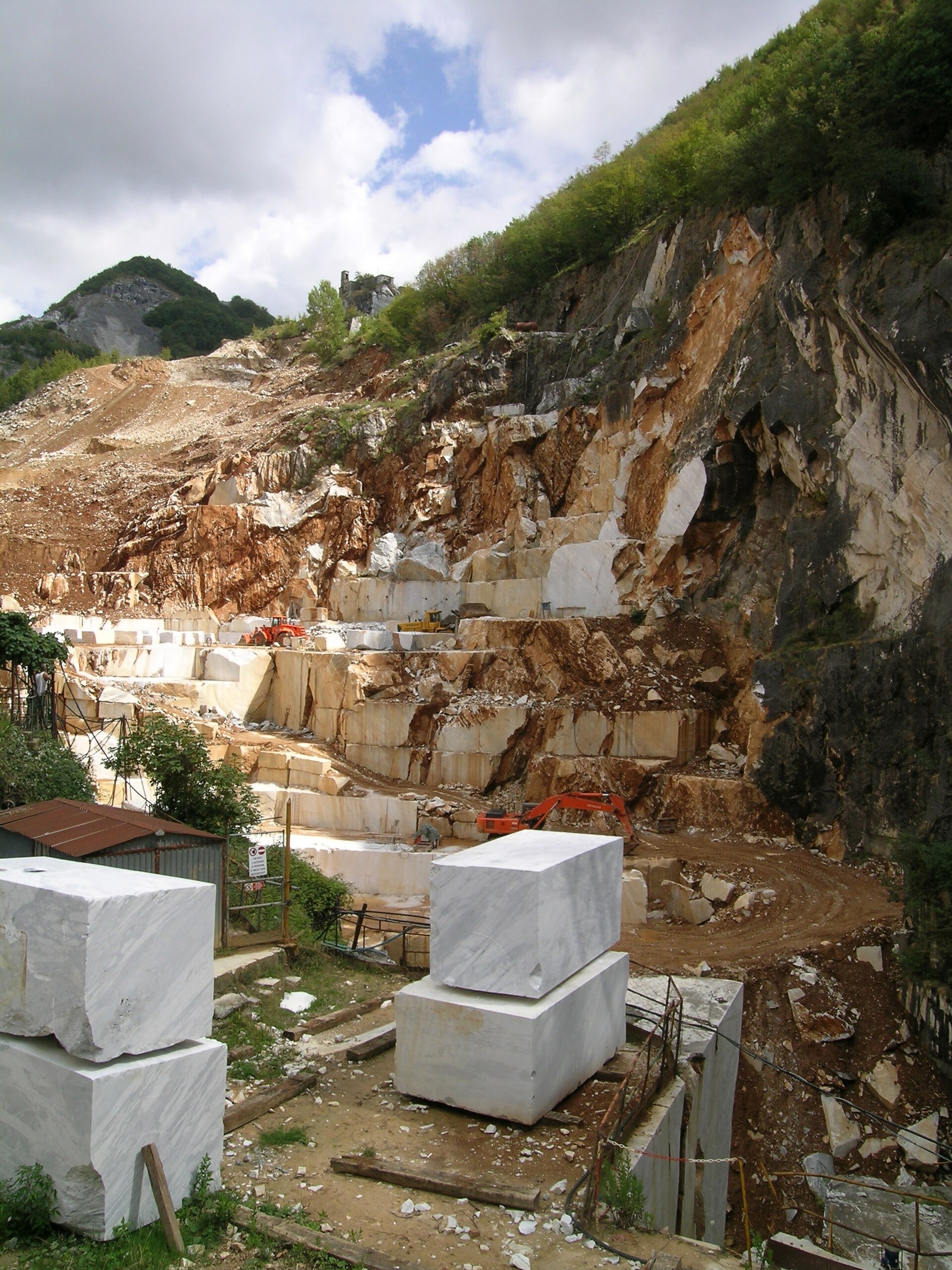
Above the town of Carrara, the green flank of the Apuan Alps breaks open into scars of white, hundreds of metres of bare rock cut into terraces and vertical faces where mountain used to be. The Apuan Alps hold evidence of at least 650 separate quarry sites, roughly half of them now abandoned or worked out after more than two thousand years of extraction. No other place on earth has produced more marble.
The Romans were already cutting it in the first century BC. Blocks were hauled down from the quarries and shipped out from the harbour at Luni, at the mouth of the river Magra a few miles south of modern Carrara, a port whose ruins still mark the point where Apuan stone first entered the wider Mediterranean trade. Luni’s marble built temples and public buildings across the Roman world; by the time the empire fell, the quarries had already been worked for centuries, and the harbour that once shipped their output had begun silting up, leaving the ruined city stranded some way inland from today’s coastline.
What made the stone worth the effort was its colour, or rather its lack of one.
Limestone squeezed clean
Carrara marble began as ordinary limestone, laid down on an ancient seabed from the compacted remains of marine organisms. Heat and pressure inside the earth’s crust, over millions of years, recrystallised that limestone into marble, a metamorphic rock built almost entirely of calcite. Most marble deposits pick up streaks of colour during that transformation, as iron, clay or other minerals trapped in the original limestone get folded into the crystal structure and show up as grey, pink or green veining, the marbled patterning that gives the rock its common name. Carrara’s finest beds, known as statuario, went through the process with almost nothing else mixed in, leaving a stone so free of impurity that light passes some way beneath its surface before scattering back out, giving it the faint inner glow sculptors call the marble’s “skin”.
Michelangelo’s own quarry
Michelangelo Buonarroti went to the quarries in person, repeatedly, rather than order blocks sight unseen. In 1505, commissioned by Pope Julius II to build the pope’s own tomb, he spent roughly eight months living among the quarrymen above Carrara, walking the faces, marking blocks with his own hand and overseeing the slow work of oxen teams hauling them down to the coast, a process that could take longer than the carving itself. Later commissions sent him back again and again over the following decades; by his own account, choosing the stone mattered to him almost as much as cutting it, since a flaw invisible in the quarry could ruin months of carving once exposed inside a block. He is said to have valued Carrara stone above almost any other, with one exception: the marble from a quarry he opened himself.
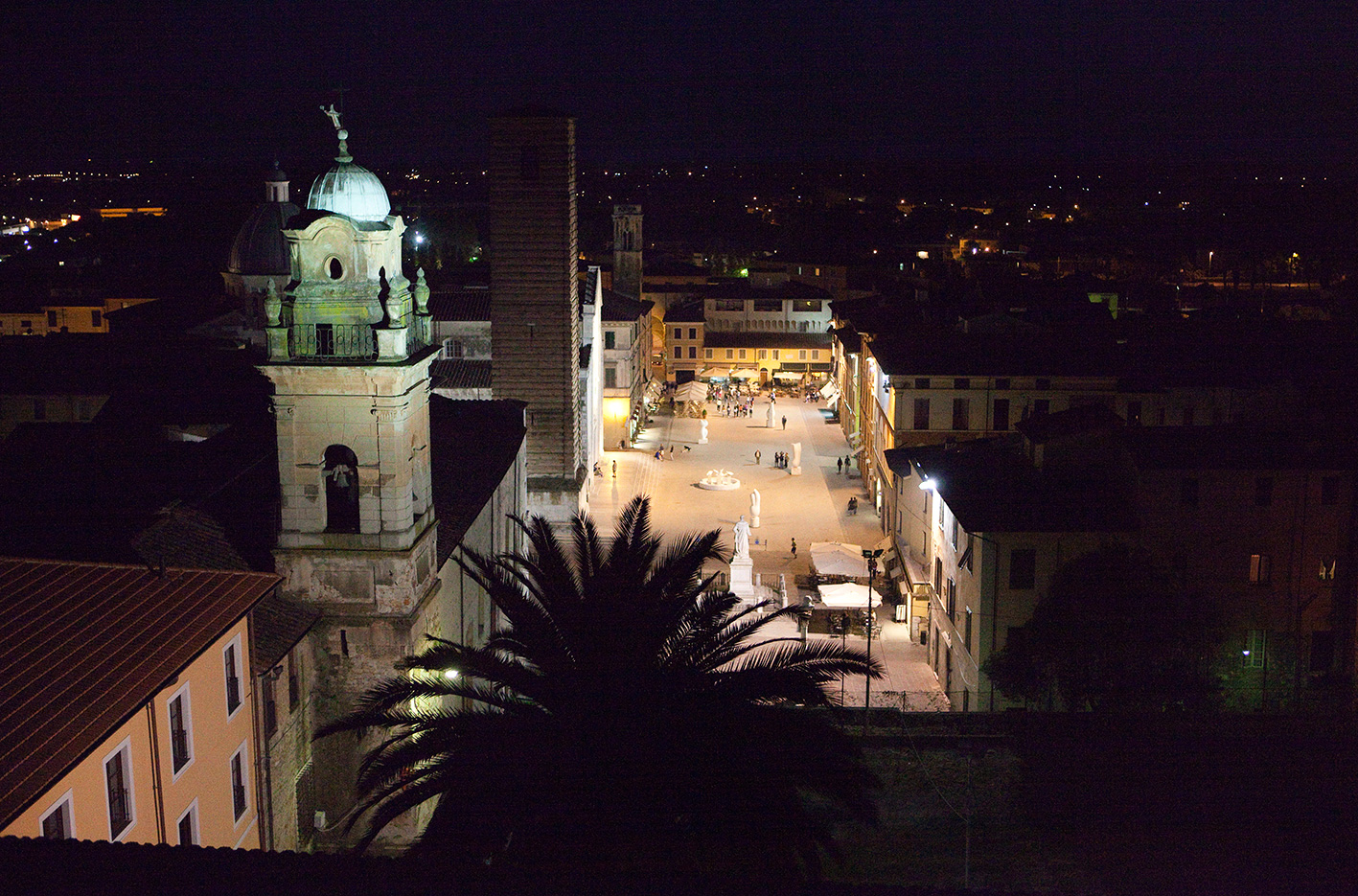
In 1516 Pope Leo X, a Medici, commissioned Michelangelo to design a new marble façade for the Basilica of San Lorenzo in Florence, the Medici family’s own church. Rather than buy stone from the established Carrara quarries, which lay outside Florentine territory and were controlled by families the Medici did not trust, Michelangelo was directed to open a fresh quarry at Pietrasanta, closer to Florentine land, and to build the road needed to bring heavy blocks out of country that had never been quarried before. The work dragged on for years, consuming money and Michelangelo’s patience in roughly equal measure. In 1520 his cash-strapped patrons cancelled the façade project outright, before it had progressed much beyond drawings, models and a half-finished road through the mountains.
Diamond wire and the export trade
Extraction has changed more in the past fifty years than in the two thousand before them. Quarrymen once split blocks with hand drills, wedges and, from the nineteenth century, explosive charges, methods that wasted a great deal of stone to cracking and rubble. Today most working faces are cut with diamond wire saws, a continuous loop of steel cable studded with diamond beads that slices through rock with far less waste and far more precision than blasting ever allowed; the same wire technology, mounted on mobile rigs, now squares off blocks in the quarry itself rather than at a mill further down the mountain. Carrara today produces marble for two quite different markets at once: a small, prestigious trade in blocks bought by sculptors and stonemasons, largely unchanged in spirit since Michelangelo’s day, and a much larger industrial trade in slabs cut for kitchen counters, floor tiles and building façades. A large share of that industrial output now leaves Italy as roughly cut blocks, to be sawn, polished and finished in factories abroad rather than in the town where it was quarried.
The white rivers
The scale of modern quarrying has its critics close to home. Cutting and polishing marble produces marmettola, a fine white sludge of rock dust and water that, if allowed to run off untreated, can coat streambeds and smother the life in mountain rivers below the quarries; residents downstream have long complained of watercourses running milky white after heavy rain. Environmental campaigners in the region, including the No Cav movement, have argued for decades that the pace of extraction is damaging the Apuan Alps themselves, a range now partly protected as the Parco delle Alpi Apuane regional park, which sits, awkwardly, around one of Italy’s most productive industrial districts. The argument pits two claims on the same mountains against each other: an industry that has employed Carrarese families for generations, and a landscape that quarrying is visibly, permanently reshaping.
Where sculptors still queue
None of that has closed the sculpture trade that first made Carrara famous. Pietrasanta, the town Michelangelo once tried and failed to turn into a quarrying centre, is today home to more than fifty marble workshops and bronze foundries, where artisans still rough out and finish work for sculptors from around the world; Fernando Botero, Joan Miró, Henry Moore and Damien Hirst have all had pieces carved or cast there, working alongside craftsmen whose own families have cut and polished stone for generations. In Carrara itself, studios along the same streets the Romans once used to move stone down from Luni continue to cut blocks to order, taking commissions from sculptors who still choose to do what Michelangelo did five centuries ago: travel to the mountain, and pick the block in person. It is a trade that has now outlasted the empire that started it by the better part of two thousand years, and shows no sign of being finished with the mountain yet.
Lead image: A quarry in the Apuan Alps above Carrara. Photo: CC BY 2.5 via Wikimedia Commons.