On the morning of 20 February 1909, readers of Le Figaro in Paris opened the newspaper to find its front page given over to a manifesto by a 32-year-old Milanese poet few of them had heard of. Filippo Tommaso Marinetti had paid for the placement himself, out of the fortune he had inherited two years earlier from his father, a lawyer in Alexandria, where Marinetti was born and raised. His text, titled simply Le Futurisme, announced the birth of a movement that did not yet have a single painting or sculpture to its name. It would acquire both within two years, and one of them would end up on a euro coin.
Marinetti’s eleven founding points called for the destruction of museums, libraries and academies, which he compared to cemeteries, and for the demolition of every city that housed them. He praised speed, the racing car and industrial machinery over classical statuary, arguing that a car’s roar was more beautiful than any inherited masterpiece, and, in the manifesto’s most notorious line, described war as “the world’s only hygiene.” The rhetoric was deliberately violent and aimed at an art establishment Marinetti considered embalmed by academic tradition and museum reverence alike. Within eighteen months a group of young Milanese and Turinese painters had turned his provocations into an actual visual programme.
That group included Umberto Boccioni, Giacomo Balla, Carlo Carrà, Gino Severini and the composer-painter Luigi Russolo, none of them older than thirty when they signed the 1910 Manifesto of Futurist Painters. Its companion text, the Technical Manifesto of Futurist Painting, translated Marinetti’s slogans into working studio principles: motion should be shown as a continuous trace across the canvas rather than a frozen instant, and the boundary between a body and the space around it should dissolve. Boccioni, the group’s most restless theorist, spent the next three years testing that idea first in paint, in canvases such as The City Rises and States of Mind, and then in three dimensions, publishing his own Technical Manifesto of Futurist Sculpture in 1912.
A body that swallows the air around it
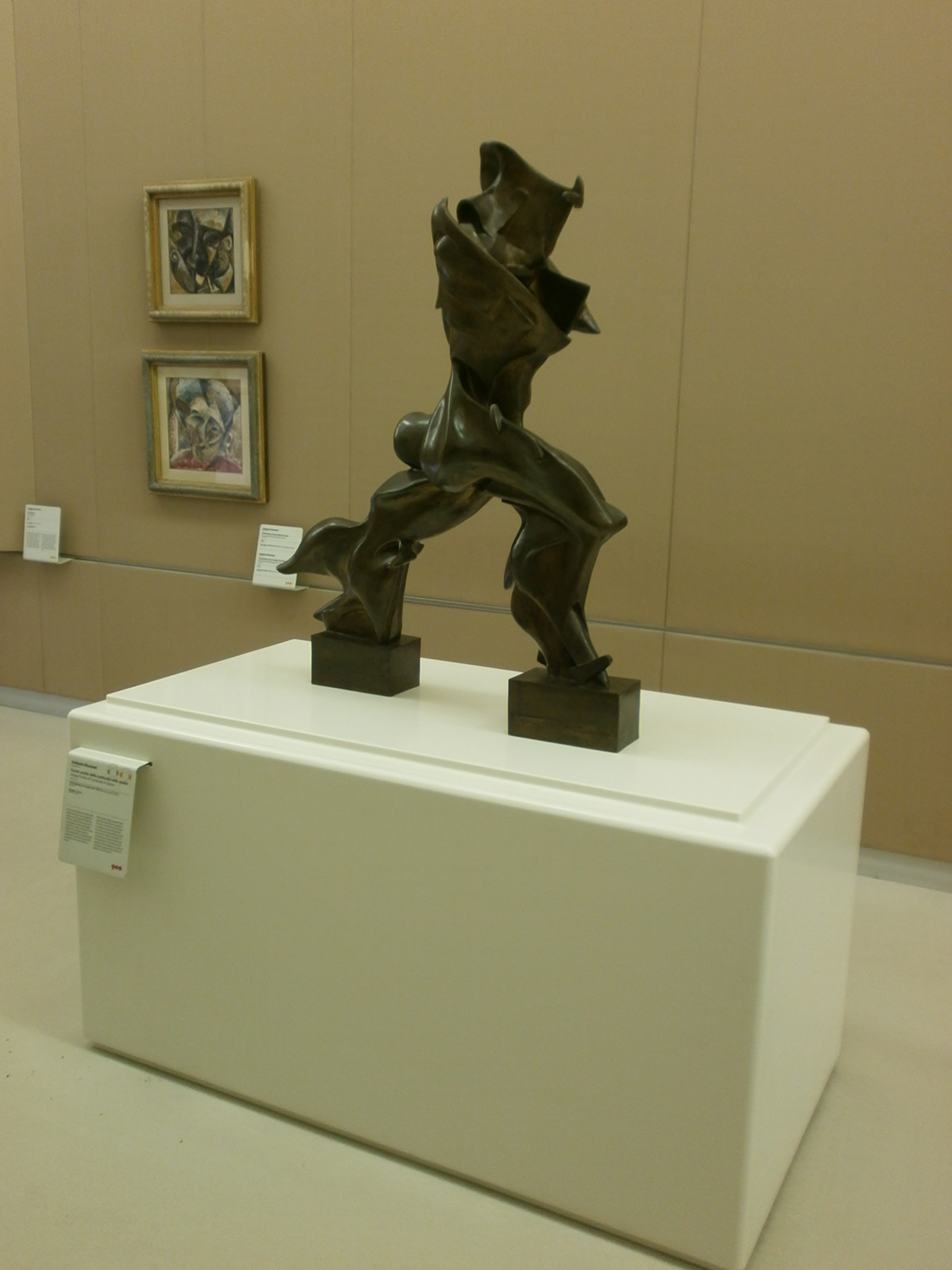
Boccioni’s Unique Forms of Continuity in Space, completed in plaster in 1913, is the result. It shows a striding figure whose muscles flare outward into wing-like, flame-like extensions, as though the air displaced by its movement had been sculpted along with the body. Boccioni intended the surface to read as continuous with its surroundings rather than sealed off from them, a direct application of the technical manifesto’s demand that sculpture “open up the figure and enclose it in environment.” He worked the piece almost entirely in plaster; contemporaries recorded that he actively distrusted bronze as a material, regarding it as part of the museum culture Marinetti wanted torn down.
That reluctance did not survive him. Boccioni died on 17 August 1916 near Verona, aged 33. He had volunteered for the war the previous year, first in a cyclists’ battalion and then with a field artillery regiment; during cavalry exercises on 16 August, his horse, which he had named Vermiglia after the red horse in his 1910 painting The City Rises, was startled by a passing military lorry, bolted and threw him, and he died of his injuries the following day. It was Marinetti, determined that his friend’s work should survive in a material sturdier than plaster, who arranged for the first bronze casts of Unique Forms to be made in the 1930s. Marinetti’s widow, Benedetta Cappa, commissioned two further casts around 1950 with rougher, more textured surfaces, and museums cast further bronzes from the original plasters in 1960 and 1972. Versions are now held by, among others, the Museum of Modern Art in New York, Tate in London, and the São Paulo Museum of Art, each object descended from a material Boccioni himself never chose.
One of those bronzes gave Boccioni a peculiar afterlife. When Italy adopted the euro in 2002, the government chose Unique Forms of Continuity in Space for the reverse of the 20-cent coin, putting a sculpture conceived as an assault on tradition into the pocket of every Italian who bought a coffee. The plaster originals themselves left Italy in 1952, sold to the Brazilian collector Francisco Matarazzo Sobrinho; a cast stands today in the Museo del Novecento in Milan, in a room devoted to the movement Boccioni did more than anyone to define.
Balla’s velocity, Russolo’s noise
The other signatories pursued the same obsession with speed by different means, and their careers outlasted Boccioni’s by decades. Giacomo Balla painted a dachshund’s legs multiplying into a blur of superimposed positions in Dynamism of a Dog on a Leash and later abandoned recognisable subjects altogether for abstract studies of velocity and light; he lived until 1958, long enough to see Futurism become art history rather than provocation. Carrà brought Futurist fracture to political subject matter in The Funeral of the Anarchist Galli, reworking his own memory of a funeral riot in Milan in 1906, which he had been caught up in as a young sympathiser of the anarchist movement, before moving toward the stiller, classicising manner of Giorgio de Chirico’s metaphysical painting in the later 1910s. Severini, based mostly in Paris and married to Jeanne, daughter of the French Symbolist poet Paul Fort, fused Futurist dynamism with Cubist structure in paintings of dancers and nightclub interiors. Russolo went furthest from painting entirely, building large wooden noise-generating machines he called intonarumori and publishing the 1913 manifesto The Art of Noises, in which he argued that the industrial soundscape of factories and traffic had made the orchestra’s traditional palette of tones obsolete.
The movement that chose a side
Marinetti’s politics were never separable from his aesthetics. He was among the founding members of the Fasci di Combattimento, which met in Milan’s Piazza San Sepolcro in March 1919 with Mussolini, and Futurism’s cult of speed, violence and youth supplied Italian Fascism with much of its early visual and rhetorical vocabulary. Marinetti broke with the party the following year over its retreat from anti-clericalism, then reconciled with the regime through the 1920s, publishing the pamphlet Futurismo e Fascismo in 1924 and eventually accepting a seat in the Royal Academy of Italy. Not every Futurist followed him; Severini and others moved away from the movement’s politics as well as its style well before the Second World War, and Boccioni’s own death in 1916 spared him the choice altogether.
What is left to see
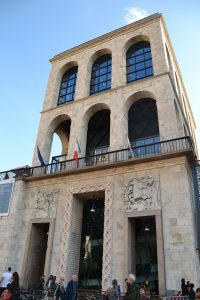
Boccioni’s paintings and the various bronze casts of Unique Forms of Continuity in Space remain the clearest entry point into what Futurism actually looked like, as distinct from what it said about itself. The Museo del Novecento‘s Futurist rooms sit a few steps from Milan’s Duomo, in the same city where Marinetti launched the movement and where Boccioni, Balla, Carrà, Russolo and the architect Antonio Sant’Elia signed their names to its early manifestos. The Metropolitan Museum’s online essay on Boccioni traces the fuller arc of his short career for readers who want the paintings alongside the sculpture. The Le Figaro front page that started it all is now itself a collector’s object, traded at auction as a printed artefact of a movement that wanted, by its own account, to have no history at all.
Lead image: Umberto Boccioni, Unique Forms of Continuity in Space, 1913 (bronze cast). Museo del Novecento, Milan.