A single canvas, painted a flat, even colour and then cut open with a Stanley knife: it looks like almost nothing happened, and that was the point. Lucio Fontana called these works tagli, cuts, and began making them in Milan in 1958, slicing through primed canvas in one confident stroke before lining the reverse with black gauze so the slit reads as a void rather than a torn edge. He had spent the previous decade working toward exactly this gesture, and it would define the rest of his career.
Fontana was born on 19 February 1899 in Rosario, Argentina, where his father, Luigi Fontana, an architect and sculptor from Varese who had emigrated in 1891, ran a studio producing architectural decoration; his mother, Lucia, was an Italian-born actress. The family moved between the two countries for most of Fontana’s life. He first came to Milan as a child for schooling, returned to Argentina, came back to Italy after the First World War to resume his studies, and trained as a sculptor at Milan’s Brera Academy under Adolfo Wildt from 1927 to 1929. He spent the Second World War years back in Buenos Aires, and it was there, in 1946, that his ideas about art and space first found a manifesto, a biography traced in detail by the Fondazione Lucio Fontana, which now oversees his catalogue and archive in Milan.
A white manifesto from Buenos Aires
In 1946 Fontana began teaching at the Escuela de Artes Plásticas Altamira in Buenos Aires, and that October a group of his students there, including Bernardo and Pablo Arias, Horacio Cazeneuve and Marcos Fridman, drafted and signed the Manifiesto Blanco, the White Manifesto, setting down ideas Fontana had been developing in his teaching rather than putting his own name to the text. It argued that painting and sculpture as inherited from the Renaissance had exhausted themselves, and called for an art that incorporated real space, movement, time and light rather than merely representing them on a flat surface. The word Fontana himself settled on for the movement that followed was Spazialismo, Spatialism, and he spent the next twenty years trying to give that idea a physical form back in Italy.
Before he settled on canvas as his subject, Fontana had already spent years testing the same ideas in clay. From 1935 he kept a second studio in Albisola, the Ligurian seaside town with a long tradition of ceramic manufacture, working at the Mazzotti factory to produce abstract, often violently gestural stoneware sculptures fired in glazes ranging from iridescent black to bright ceramic colour. That willingness to treat a surface as something to be physically disturbed, rather than only painted, carried directly into the ideas he brought back from Argentina in 1946.
His first attempt at translating Spatialism onto canvas came in 1949, after his return to Milan, when he began puncturing sheets of paper and then canvas with a sharp tool to create small, evenly spaced perforations he called buchi, holes. Seen from the front, a punctured white canvas throws faint shadows around each opening, and seen from behind, light passes through in visible points; Fontana had turned the canvas from an opaque support into something the room’s own light could pass through, so that the work changed depending on where a visitor stood and how the gallery was lit that day. He refined the technique for nearly a decade before arriving at the cut, a single continuous incision, sometimes several parallel incisions, made with a blade in one unhesitating pass through primed, monochrome canvas.
What is behind the slit
The gesture looks spontaneous, and Fontana wanted it to; he made the cuts quickly, standing over a canvas laid flat or propped at an angle, and rarely reworked one once it was made. But the finished object required deliberate preparation behind the visible surface. Fontana glued a strip of black garza, gauze, to the reverse of the canvas before or during the cutting, so that the opening does not reveal a raw hole through to the wall but a controlled band of shadow, consistent in tone across the whole edition of works. The combination of an apparently violent act and a carefully engineered result became the signature tension of his late career, sold under the recurring title Concetto spaziale, Spatial Concept, with the cuts or holes as a subtitle.
An arabesque of light over the Triennale staircase
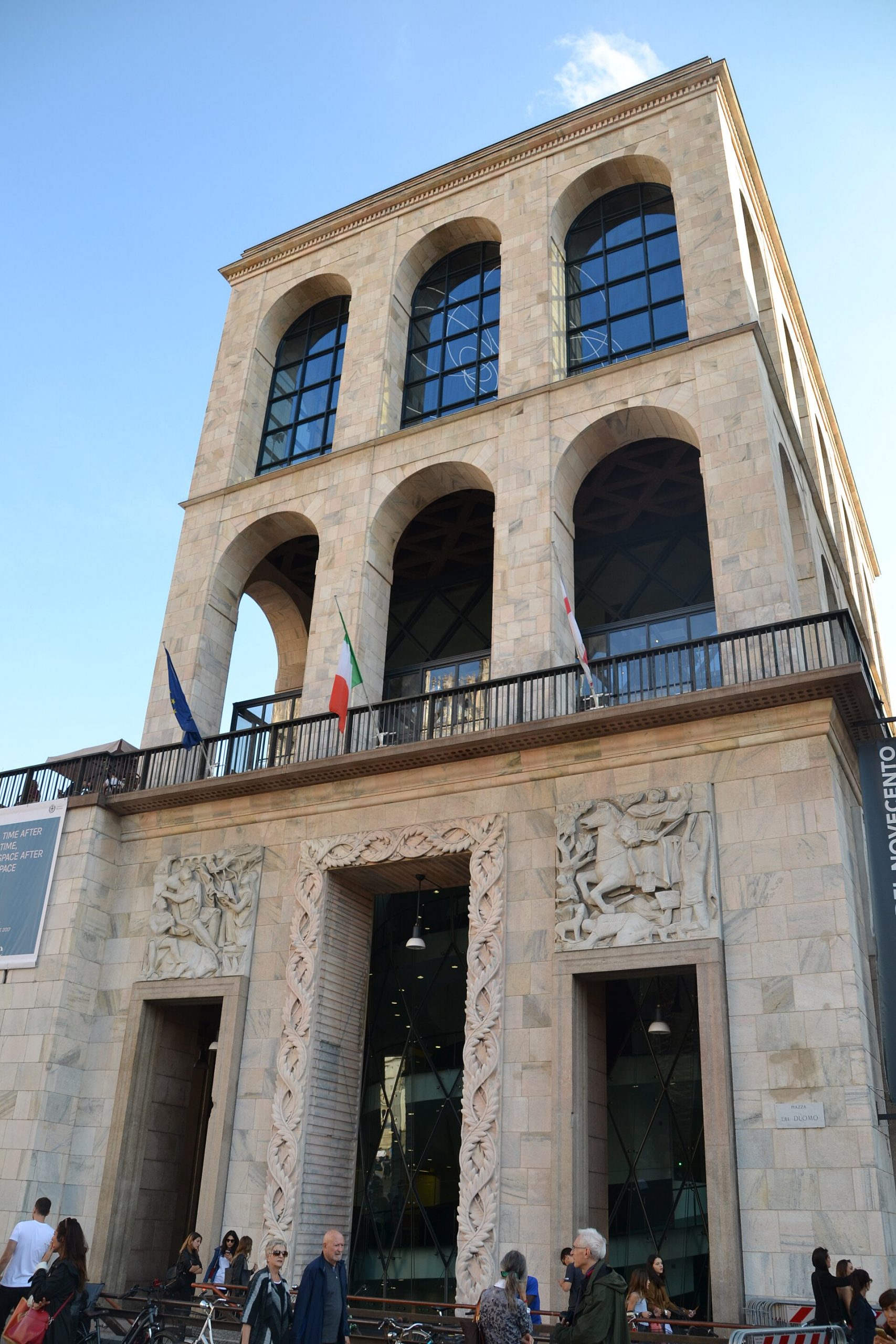
Fontana’s other major spatial experiment used neon rather than canvas. For the ninth Milan Triennale in 1951, he was commissioned to fill the void above the exhibition’s grand staircase, and he responded with a Struttura al neon, an arabesque of white neon tubing roughly one hundred metres long, bent by hand into loops and suspended on steel cables above the stairwell. It was meant to be seen from below as visitors climbed, a drawing made of light rather than pigment, floating in three-dimensional space exactly as the White Manifesto had demanded, a story the museum’s own director has retold in detail. The installation did not survive the exhibition’s close, but Fontana’s idea did: the Museo del Novecento in Milan now houses a later realisation of the neon structure in a room with a fully glazed wall overlooking Piazza del Duomo, so the arabesque is visible to anyone crossing the square after dark.
What the market pays now
Fontana died in Comabbio, near Varese, on 7 September 1968, at the age of 69, by which point his cuts were already sought after internationally; he had shown an entire room of them at the 1966 Venice Biennale, in a display designed with the architect Carlo Scarpa that won the Biennale’s painting prize. His market has continued to climb since. Concetto spaziale, La fine di Dio, an egg-shaped 1963–64 canvas in vivid yellow, perforated with dozens of holes arranged like a constellation, sold for £17.2 million at Christie’s in New York in November 2015, still cited as his auction record. It remains a striking outcome for an artist who spent two decades insisting that painting, as a fixed and finished object, no longer mattered.
Where to see the cuts today
The Museo del Novecento holds both the neon environment and a room of paintings tracing Fontana’s route from the perforated buchi to the mature tagli, a short walk from the Duomo where his career in Milan effectively began. His birthplace of Rosario retains its own claim on him: the city’s Museo Municipal de Bellas Artes Juan B. Castagnino holds early works from before his return to Italy. In Milan, the room built around his neon arabesque continues to glow over Piazza del Duomo each evening, a fixed version of a gesture Fontana always meant to look temporary.
Lead image: The Museo del Novecento, Milan, which houses Fontana’s neon environment and a room of his paintings.