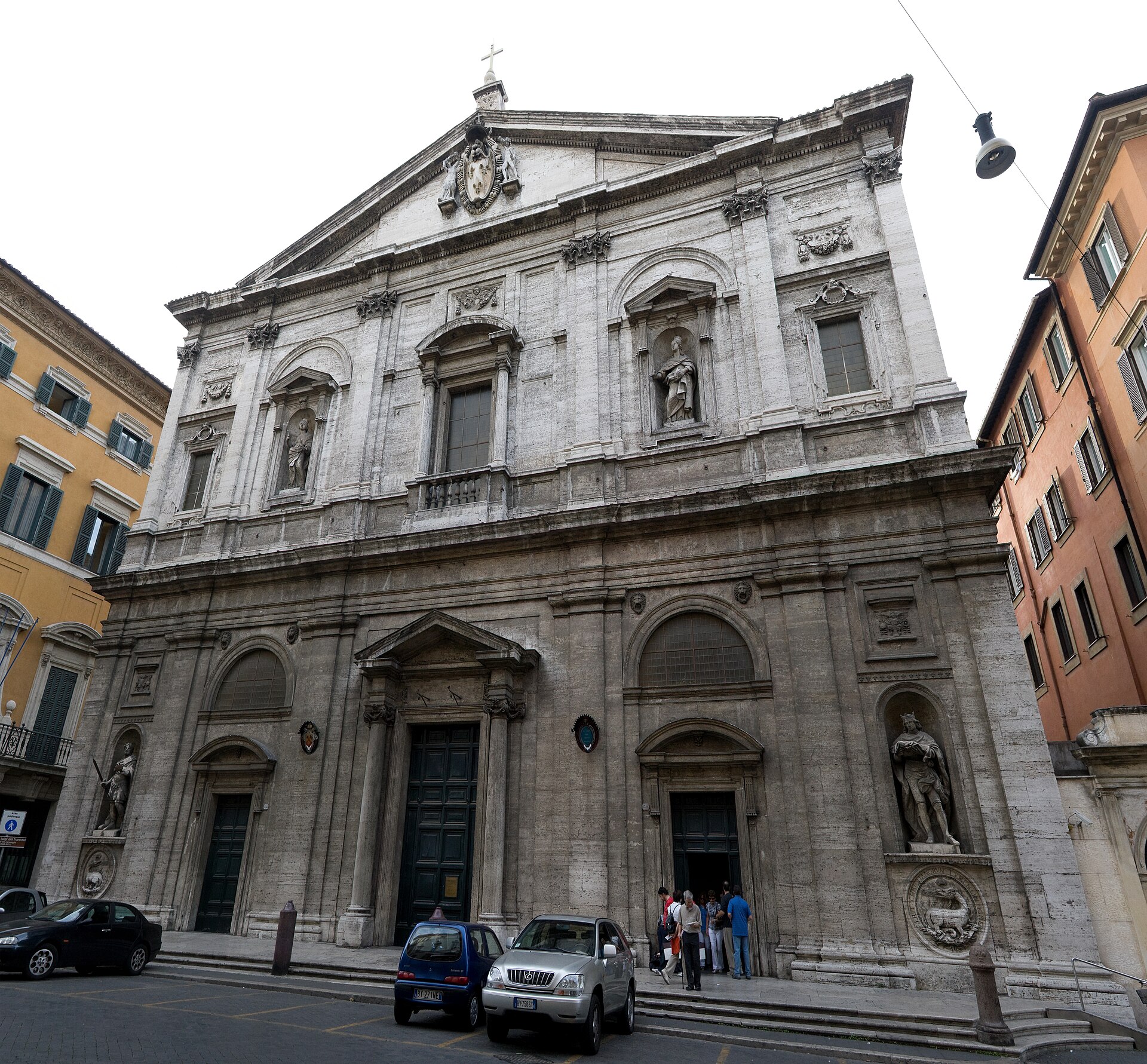
Drop a coin in the slot on the right-hand wall of the last chapel on the left in San Luigi dei Francesi, and for a minute or two the room’s darkness gives way to three paintings that changed what a picture of a saint could look like. The chapel belongs to Cardinal Matteo Contarelli, a French cleric who bought it in 1565 and never saw it finished; the three canvases inside are by Michelangelo Merisi da Caravaggio, painted between 1599 and 1602, when he was still in his twenties and largely unknown outside a small circle of Roman patrons.
Before Caravaggio, the commission had sat unfinished for over three decades. Contarelli’s will, drawn up before his death in 1585, specified scenes from the life of his name-saint, Matthew the Evangelist: a martyrdom and a calling on the side walls, an altarpiece of Matthew writing his Gospel guided by an angel. The painter Giuseppe Cesari, known as the Cavalier d’Arpino, frescoed the chapel’s vault by 1593 but never got to the walls, distracted by grander commissions for the papal court.
The altarpiece proved even harder to place. Contarelli’s will had called for a marble sculpture of Matthew and the angel rather than a painting, and the Flemish sculptor Jacob Cobaert spent years on a statue that the executors eventually rejected, reportedly because it lacked the angel the will required. By 1597 the funds set aside for the whole project had been handed over to the Fabbrica di San Pietro, the Vatican’s own building office, and had sat there for two years producing nothing. Cardinal Francesco Maria del Monte, Caravaggio’s patron at the time and a man with real influence over the executors, put the young painter’s name forward, and on 23 July 1599 Caravaggio signed a contract to paint the two side canvases. It was his first major public commission, and his first chance to work at a scale larger than the private cabinet pictures of musicians, cardsharps and fruit he had been painting for del Monte’s household.
A beam of light doing the work of theology
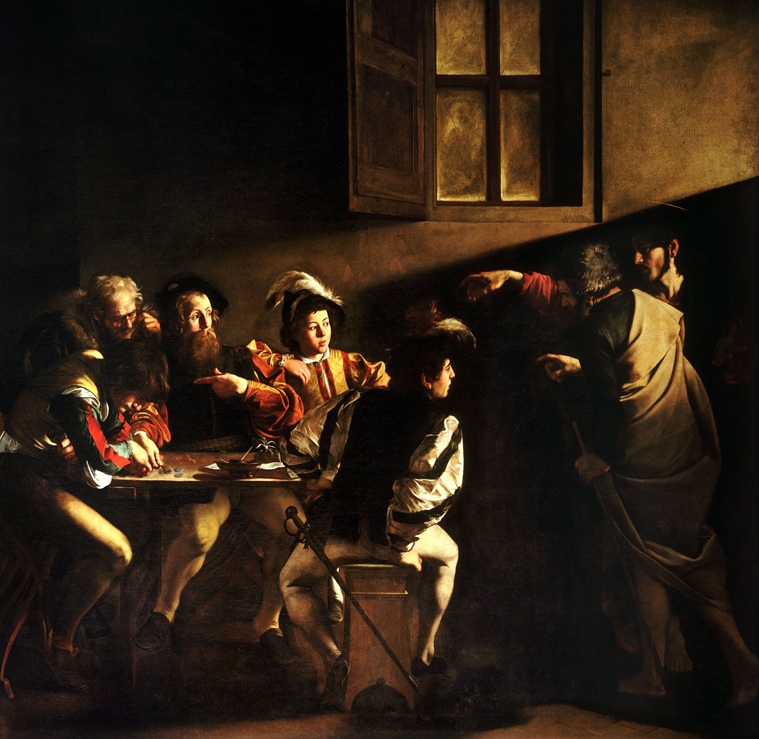
The Calling of Saint Matthew, on the chapel’s left wall, shows a group of men counting money at a table in a dim tavern-like room when Christ appears at the edge of the scene and points. A single shaft of light, entering from a source outside the picture, cuts diagonally across the composition and lands on the faces of the men at the table, several of whom look up in surprise or confusion, uncertain, as centuries of viewers have been, exactly which of them is Matthew. The device, later given the name tenebrism by historians, uses light itself to stage the moment of conversion rather than relying on gesture or expression alone; Christ’s outstretched hand, deliberately close in pose to Adam’s in Michelangelo’s Creation of Adam on the Sistine ceiling, casts him as a second Adam calling a new kind of humanity into being.
Exactly which figure at the table is Matthew has been argued over for decades. The traditional reading points to the bearded, richly dressed man near the centre, one hand still on his coins, who touches his own chest as if asking “who, me?” A rival reading, argued by some scholars from the direction of his downward gaze, holds that Matthew is instead the young man at the far end of the table, still counting money and unaware that Christ’s gesture is meant for him at all. Caravaggio left the ambiguity unresolved, which is itself unusual for a devotional commission meant to instruct as much as move its viewers.
The martyrdom on the opposite wall
Facing the Calling across the chapel, The Martyrdom of Saint Matthew shows the saint struck down at an altar by an assassin sent to kill him, his attendants and congregation scattering around him in a crowded, violent scramble. A self-portrait is generally accepted among the fleeing figures at the picture’s edge, Caravaggio looking back over his shoulder at the killing, a signature of presence rather than a signed name, since Caravaggio hardly ever inscribed his paintings. Infrared reflectography carried out in the twentieth century found two earlier, abandoned compositions beneath the paint layer: a first attempt crowded with small figures set against heavy architecture, in the manner of Cesari’s Mannerist vault above, and a second, Raphael-influenced version with a larger cast of onlookers. Caravaggio scraped both away and settled on the sparer, close-up arrangement now visible, stripping out the architecture and reducing the number of actors so that the eye goes straight to the assassin’s raised arm. A high-resolution digitisation project carried out by the Factum Foundation has since scanned all three canvases in extreme detail, giving conservators and scholars a reference record independent of the chapel’s difficult lighting.
A first attempt too poor for the altar
The altarpiece gave Caravaggio the most trouble. His first version of Saint Matthew and the Angel showed the evangelist as a bald, coarse-featured labourer, his foot thrust toward the viewer, being guided to write by an angel who pressed close against him and physically steadied his hand on the pen. The chapel’s clergy rejected it, reportedly finding it too undignified and too physically intimate between saint and angel for an altarpiece. Caravaggio painted a second version, the one still in place today, showing Matthew as a bearded, seated scholar in flowing robes, pen poised, with the angel now hovering above him rather than touching him.
The rejected first version did not simply disappear. It was bought by the banker and collector Marchese Vincenzo Giustiniani, one of Caravaggio’s most important patrons, and passed eventually into the Kaiser Friedrich Museum in Berlin. Moved to a flak tower for safekeeping during the Second World War, along with hundreds of other paintings considered too valuable to leave exposed to bombing, it was destroyed in a fire that swept through the tower’s contents at the war’s end in 1945. What survives of it now is a handful of black-and-white photographs taken before the war, the only record of a composition the chapel’s own clergy once judged unfit to hang above an altar.
Seeing it today, one euro at a time
San Luigi dei Francesi remains a working church, not a museum, and the Contarelli Chapel is lit for viewing by a coin-operated box on the wall beside it: a euro buys roughly ninety seconds of electric light on the canvases before the chapel returns to its ordinary gloom. Without it, the paintings sit in the same low light Caravaggio’s own contemporaries would have seen them by, illuminated only by whatever daylight reaches the chapel from the church’s windows. The church is open Monday to Saturday in two sessions, mornings and afternoons, and on Sunday afternoons, closing for the morning on the first Wednesday of each month; there is no admission charge. The church’s own website lists current hours, which shift around Roman public holidays and the August closures common across the city’s churches, along with a free smartphone audio guide covering all three canvases.
Lead image: Caravaggio, The Calling of Saint Matthew, 1599–1600. Contarelli Chapel, San Luigi dei Francesi, Rome.