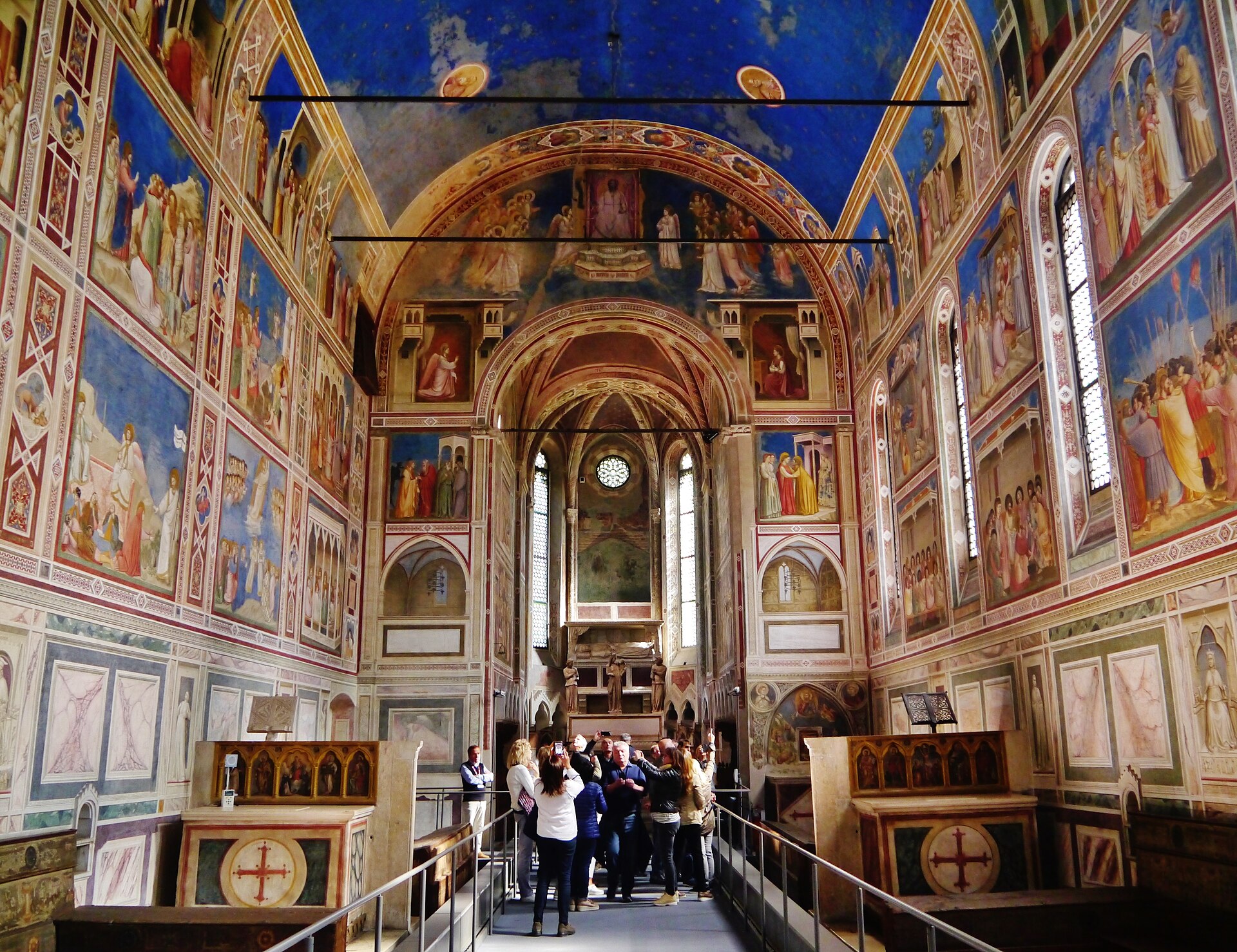
The scaffolding came down in Padua in 1305, and for the next seven centuries visitors have walked into a room painted the colour of a clear night. The Scrovegni Chapel is a single barrel-vaulted hall, thirty metres long, attached to a palace that no longer stands. Its walls carry thirty-eight scenes from the lives of the Virgin and Christ, painted by Giotto di Bondone in a campaign that art historians place at around 1303 to 1305. Nothing else from the period looks quite like it.
The building was a private commission, not a parish church. Enrico Scrovegni, a Paduan nobleman who had inherited a fortune built on moneylending, bought a plot on the ruins of Padua’s Roman arena in 1300 and built himself a grand palace there, with the chapel attached as his family’s place of worship. The site gave the building its other common name, the Arena Chapel. Giotto, already established as the leading painter in central Italy after work in Assisi and Rome, was given the whole interior to fill: vault, side walls, entrance wall, and altar end, an unusually complete commission for a single artist to control from start to finish.
What makes the chapel a hinge point in Western painting is not only its condition, which is exceptional, but the manner of the storytelling. Giotto gave his figures weight, turned their heads to look at one another, and let grief, anger and tenderness show on their faces in a way Byzantine-influenced painting in Italy had not attempted.
A palace built on interest
Enrico Scrovegni’s father, Reginaldo degli Scrovegni, was a moneylender notorious enough to be placed by Dante in the seventh circle of the Inferno, among the usurers, seated under a rain of fire with a purse bearing his family’s coat of arms hung round his neck. Enrico inherited both the fortune and the reputation. Traditional accounts hold that the chapel was built to atone for his father’s sin of usury, and Enrico’s own practice of lending at interest on a large scale did nothing to quiet the association.
Modern scholarship is more cautious about the atonement story. The chapel was consecrated to the Virgin of Charity and stood attached to Enrico’s own palace, built for his personal and family use rather than for public worship, which suggests a display of status and piety combined at least as much as private guilt. Enrico died in exile in Venice in 1336, having been banished from Padua in 1328 during a period of civil unrest. The family palace beside the chapel outlived him by five centuries before it was demolished in 1827 to sell off its stone and fittings and build housing on the site; only the chapel itself was later saved, bought by the municipality of Padua in 1881 and restored.
A colour worth more than gold
The vault and much of the pictorial ground is painted a deep, saturated blue, made from ground lapis lazuli imported by sea from mines in Afghanistan, then the only significant source of the stone in the medieval world. Ultramarine, literally “from beyond the sea”, was at the time the single most expensive pigment available to a painter, costing more than gold by weight once shipped, ground and purified. Its lavish use across the entire chapel, rather than reserved for a single figure of the Virgin as was customary, signals how much money Scrovegni was prepared to spend on the commission.
Fresco painting, buon fresco in Italian, is unforgiving of that kind of extravagance. Pigment is applied to a thin skim of wet plaster and bonds to the wall chemically as the plaster dries, which means a painter can only cover the area he can finish in a single working day, known in the trade as a giornata; the joins between one day’s patch of plaster and the next are still visible on close inspection across the chapel’s walls. Ultramarine could not survive that process, because the lime in fresh plaster is too alkaline for the pigment. Giotto and his workshop instead applied the blue afterwards, a secco, onto plaster that had already dried, using egg or glue as a binder rather than the lime itself.
Weight, gesture, and a human Christ
Byzantine-influenced painting in Italy before Giotto favoured flat, frontal figures, gold backgrounds and formulaic gesture. Giotto broke from that vocabulary. His bodies have mass and stand convincingly on the ground; his crowds turn and react to one another rather than facing the viewer in a row. In the Lamentation, mourners bend low over the dead Christ with their backs to the viewer, an arrangement that pulls the eye into the scene rather than presenting it as an icon. Even the domestic detail is new: in the Annunciation to Saint Anne, a maidservant spins wool by the door while, unnoticed by her, an angel appears at the window above.
The wall you turn to leave by
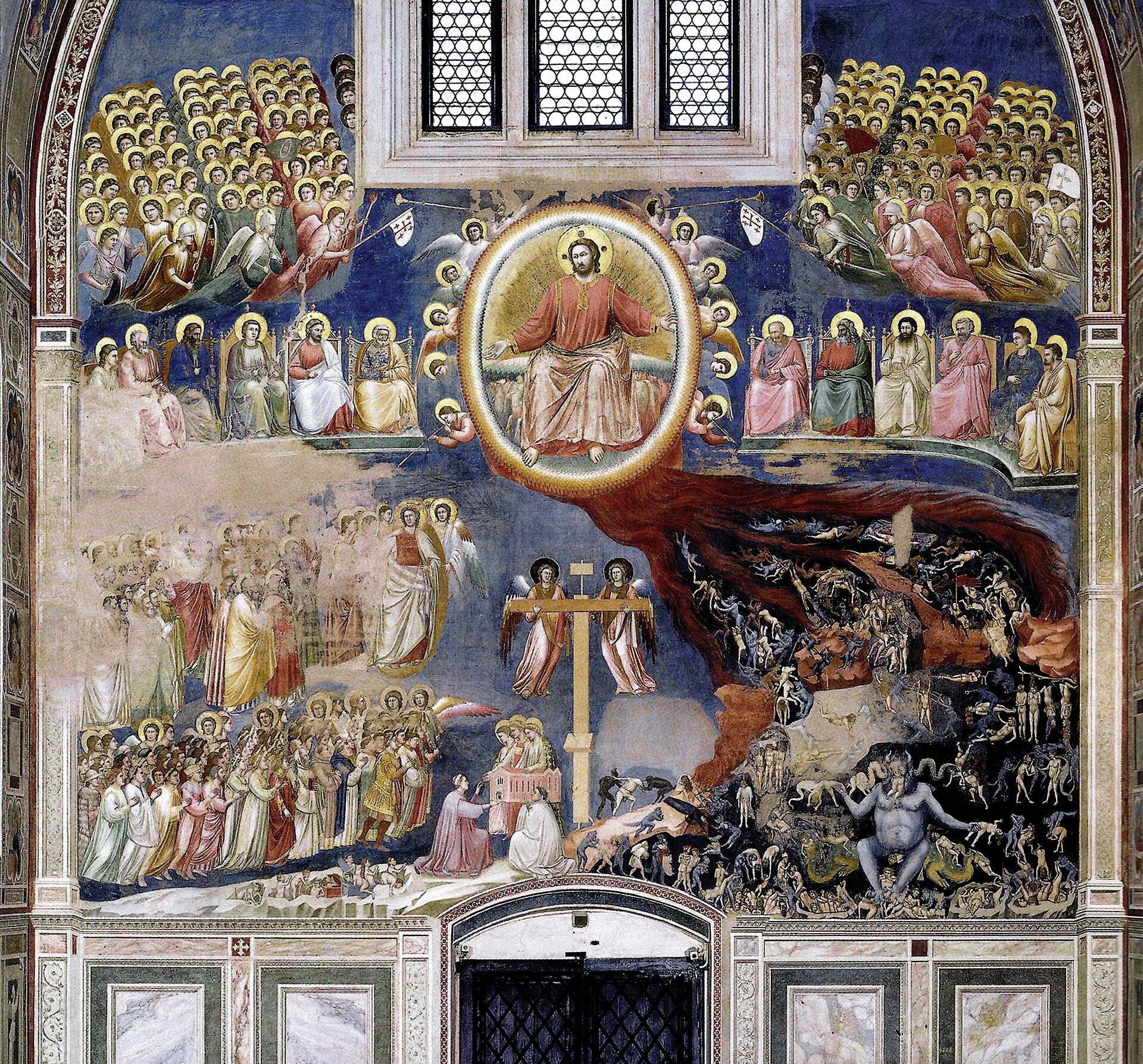
The entrance wall, the one visitors pass beneath on their way out, carries the chapel’s largest single scene: a Last Judgement roughly the size of the whole wall, with Christ enthroned in a mandorla at the centre, the saved rising on one side and the damned dragged into a chaotic hell on the other. Low on the composition, kneeling among the blessed, Enrico Scrovegni himself appears in a painted portrait, offering up a model of the chapel to three haloed figures. It is one of the earliest instances in Italian fresco painting of a patron placing his own likeness this close to the sacred scene he paid for.
Twenty minutes in a sealed room
The frescoes’ survival is now managed as tightly as their painting was once ambitious. Because carbon dioxide and humidity from visitors’ breath threaten the pigment, groups of no more than twenty-five people are admitted at a time, and every group first spends around fifteen to twenty minutes in a climate-controlled anteroom that dehumidifies and filters the air they carry in with them, while a short introductory film plays. Only after that does the door to the chapel itself open, for a visit that typically also runs to fifteen or twenty minutes, longer on some evening slots.
A World Heritage listing, four centuries late
Recognition from UNESCO came only in July 2021, when the organisation inscribed “Padua’s fourteenth-century fresco cycles” as a World Heritage Site, a listing covering eight religious and civic buildings across the city painted between 1302 and 1397, including the Scrovegni Chapel, the Basilica of Saint Anthony, the Palazzo della Ragione and the Baptistery. The inscription describes Giotto’s chapel cycle as marking the beginning of a revolutionary development in the history of mural painting, and treats the seven other cycles, by artists including Giusto de’ Menabuoi and Altichiero da Zevio, as its direct legacy. Today the chapel is run by the Musei Civici di Padova, and bookings for the timed slots are required well in advance, particularly at weekends.
Lead image: Giotto di Bondone, Last Judgement, c. 1303–1305. Scrovegni Chapel, Padua.