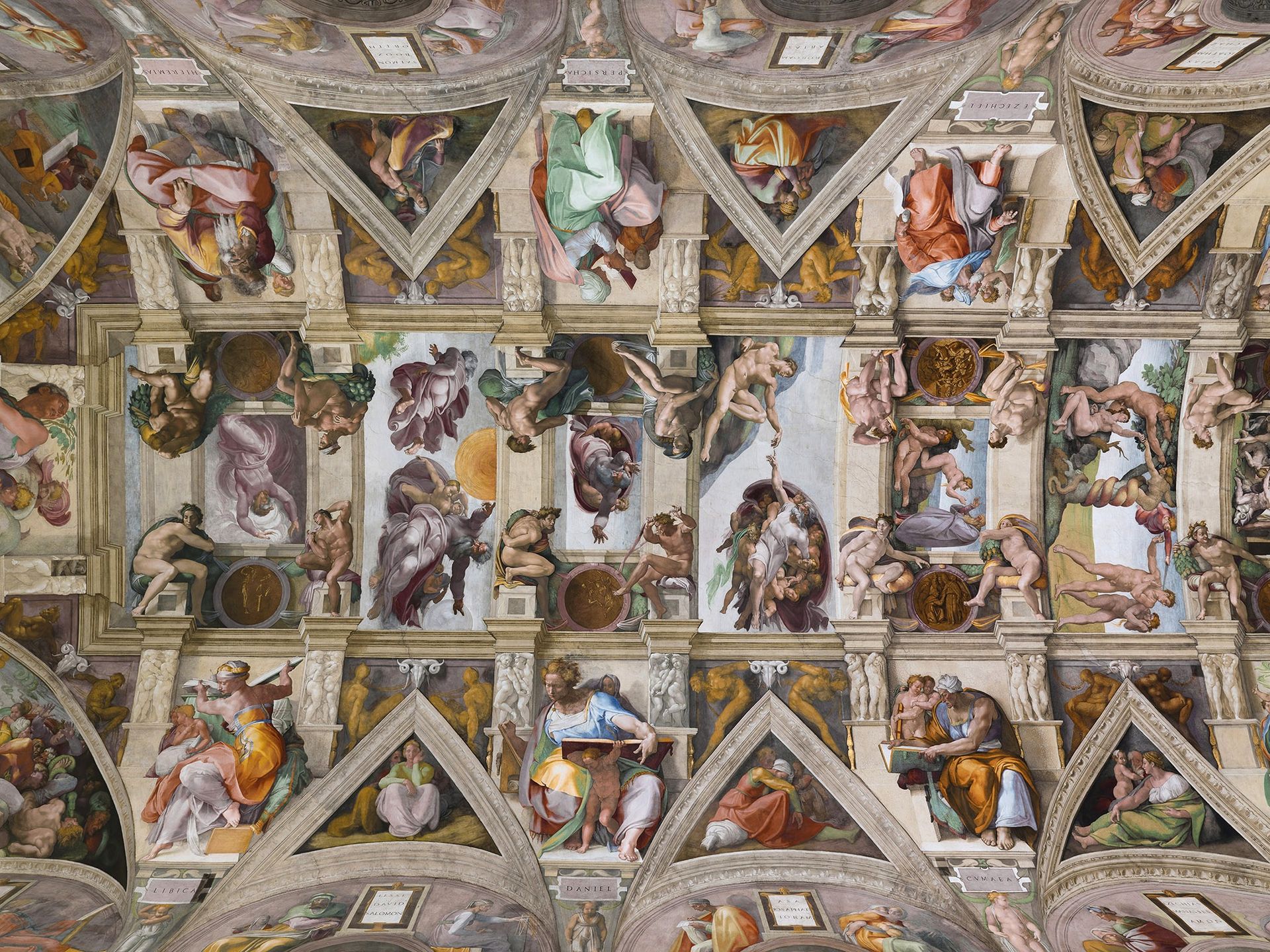
For nearly four and a half centuries, visitors to the Sistine Chapel saw Michelangelo’s ceiling through a haze of candle soot, incense smoke and the residues of earlier, well-meaning repairs. Restorers in the eighteenth and again in the 1930s had brushed on animal glue and oil to revive colours dulled by grime, and those coatings had themselves darkened and yellowed over time, trapping still more dirt beneath them. By the late twentieth century, the ceiling that generations of art historians described as sombre and shadowy was, in large part, simply dirty.
Gianluigi Colalucci, head restorer at the Vatican’s Laboratory for the Restoration of Paintings, began test cleanings in 1979 and started work in earnest the following June. What followed was the most closely watched restoration in the history of art, and one of the most bitterly contested. Michelangelo painted the ceiling between 1508 and 1512, working largely alone on the highest sections despite popular legend crediting him with lying flat on his back; contemporary accounts and the scaffolding drawings that survive show him standing, craning upward, for months at a stretch.
Fourteen years, three campaigns
Colalucci’s team worked through the chapel in three stages. The lunettes, the curved sections above the windows depicting Christ’s ancestors, came first, from June 1980 to October 1984. The main vault followed, October 1984 to December 1989, unveiled by Pope John Paul II on 8 April 1994. The altar wall’s Last Judgement and the remaining wall frescoes by Perugino, Botticelli and others were treated last, finished in December 1999. Working from scaffolding suspended on rails, conservators applied a mild gelatine and ammonium-bicarbonate solvent in controlled stages, testing each patch before moving on, then washed the surface with distilled water and stabilised flaking plaster with an acrylic resin.
The campaign followed guidelines set down in 1978 by Carlo Pietrangeli, then director of the Vatican Museums, who insisted on documenting every square centimetre photographically before and after cleaning and on testing solvents on small, inconspicuous patches first. Colalucci worked alongside a small permanent team, including Maurizio Rossi and Piergiorgio Bonetti, rotating through the scaffolding in shifts to keep the pace slow enough to catch problems before they spread across a fresco that could not, in any real sense, be redone.
Centuries of soot, and the drapery painted on afterward
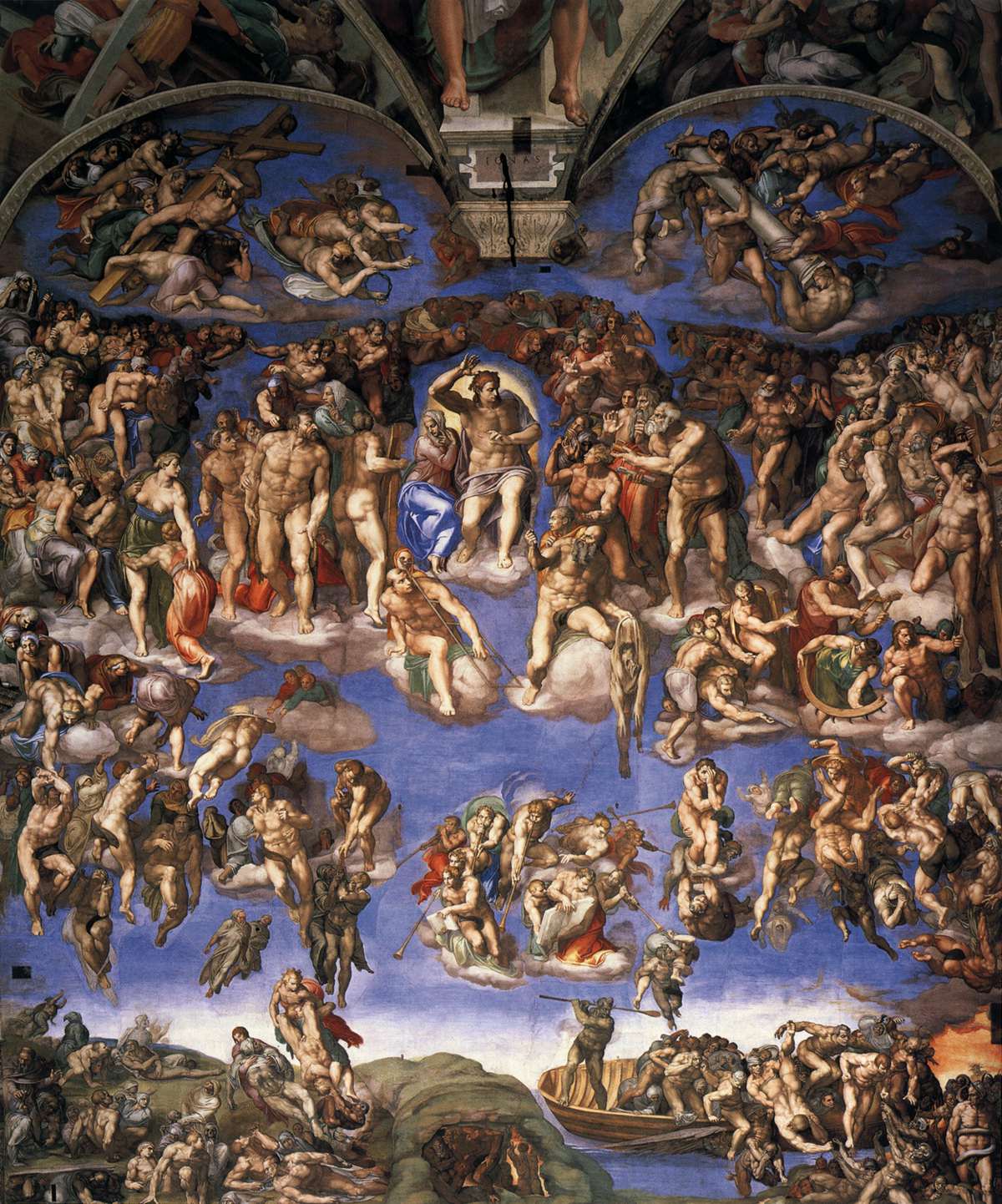
The cleaning removed roughly four hundred years of candle grime, salt efflorescence from water seepage, and the oil and glue coatings of earlier restorers, revealing colour saturation nobody alive had seen on the ceiling. It also confronted a stranger layer of accretion on the Last Judgement: painted-on loincloths, or braghe, added from 1565 by Daniele da Volterra and later hands after the Council of Trent judged Michelangelo’s nudes indecent. Volterra had scraped away the original plaster before repainting, so removing his additions would have exposed bare wall rather than restored figures. Colalucci’s team managed to remove 17 of the roughly 40 loincloths where the underlying paint survived; the rest stayed, an involuntary record of Counter-Reformation censorship left in place because undoing it was no longer physically possible.
“Like an orange peel”: the case against the cleaning
The Columbia University art historian James Beck became the restoration’s most persistent critic, arguing through the 1980s and 1990s that Colalucci’s solvents were stripping away more than dirt. Beck’s contention, developed with the organisation he founded, ArtWatch International, was that Michelangelo had finished large areas of the ceiling a secco, painting on dry plaster after the wet buon fresco layer had set, using glazes and carbon-black washes to add shadow, depth and the dramatic modelling the ceiling was famous for. If restorers treated those final touches as later grime rather than the artist’s own work, Beck argued, they risked scrubbing away exactly the qualities that made Michelangelo’s figures appear sculptural rather than flat.
He pointed to specific losses, documented at length by ArtWatch International: eyes rendered a secco that vanished during cleaning, architectural details such as acorns and scallop shells that lost their crispness, and the figure of Jonah, whose foreshortened torso Beck felt had flattened into a paler, less dimensional form. “How many times can people go through this without their poor faces looking like an orange peel,” he asked, comparing the ceiling’s fate to an over-restored painting stripped of its own patina. In 1987, fifteen artists including Andy Warhol, Robert Motherwell and Christo signed a petition, organised by the dealer Ronald Feldman, asking Pope John Paul II to halt both the Sistine project and the parallel cleaning of Leonardo’s Last Supper in Milan. Colalucci and the Vatican maintained that Michelangelo worked overwhelmingly in true fresco and that what critics mourned as lost shadow was in fact discoloured varnish; the exchange never fully resolved, and Beck published his case at length in Art Restoration: The Culture, the Business and the Scandal before his death in 2007.
A Japanese broadcaster’s exclusive
The restoration’s other lasting controversy was financial rather than art-historical. In 1980, Nippon Television Network Corporation agreed to fund the bulk of the four-part campaign, contributing roughly US$4.2 million in exchange for exclusive rights to photograph and reproduce images of the work in progress. A staff photographer, Takashi Okamura, documented the ceiling stage by stage, but the broadcaster released little of that material publicly, eventually issuing a limited two-volume book priced at around US$1,000. The New York Times chief art critic Michael Kimmelman called the arrangement “ungenerous” in 1991, arguing that withholding detailed documentation from independent scholars made it harder to settle exactly what the cleaning had removed and made the Vatican’s assurances harder to test. Nippon Television’s funding nonetheless covered a project the Vatican itself could not otherwise have afforded on its own conservation budget, and similar broadcaster-funded arrangements later became common practice for major Italian restorations, including the cleaning of Leonardo’s Last Supper in Milan through the 1980s and 1990s.
What the chapel manages now
The argument over the cleaning has outlived most of its original combatants, but the chapel itself has moved on to a newer problem: managing the roughly six million visitors a year who now pass beneath the restored ceiling. In October 2014, the Vatican Museums installed a climate and lighting system built by Carrier, replacing incandescent floodlights with more than 7,000 LED fixtures calibrated to Colalucci’s restored palette, alongside sensors that track visitor numbers in real time and adjust temperature and humidity to limit the moisture, dust and carbon dioxide that thousands of bodies bring into the room each day. On a full afternoon the chapel can hold roughly 2,000 people at once, still walking beneath a ceiling whose true colours, thirty years after the scaffolding finally came down, remain a matter of professional disagreement.
Lead image: Michelangelo, The Last Judgement, 1536–1541. Sistine Chapel, Vatican.