An ageing Florentine painter began the job, and a serious illness ended his part in it. Bicci di Lorenzo started frescoing the choir of the Basilica of San Francesco in Arezzo in 1447, working from the top down as fresco convention required, and had finished the vault’s four evangelists, two church fathers and a Last Judgement on the entrance arch by the time he fell seriously ill in 1452. He died shortly afterwards, leaving the great bulk of the chapel’s walls bare. Piero della Francesca took over the commission that same year and spent the next fourteen years, on and off, filling them with one of the strangest and most mathematically exact narrative cycles of the Italian Renaissance.
The subject was fixed before either painter arrived. The chapel’s patrons, the Bacci, a family of Arezzo merchants acting on a bequest their ancestor Baccio di Maso Bacci had left in his will in 1417, wanted the Legend of the True Cross, a medieval story tracing the wood of Christ’s cross from a seed planted in Adam’s grave through to its rediscovery by the Byzantine emperor Heraclius. It was a natural subject for a Franciscan church, given Saint Francis’s own devotion to the cross, but a demanding one to paint, spanning centuries and continents across ten large scenes on three walls.
By the time the frescoes were finished, references to them in the past tense appear in the historical record from 1466 onward, suggesting Piero had completed the cycle by then, though no contract or payment document for the Arezzo commission survives to fix his working dates more precisely.
Piero did not paint the story in the order it happened. He used the chapel’s shape and the logic of visual symmetry rather than strict chronology to decide where each scene went, pairing thematically related episodes so they face one another across the chapel rather than reading in sequence around the walls. In one scene the Queen of Sheba kneels in adoration before a wooden beam she recognises as sacred, on her way to meet King Solomon; the beam is the wood that will eventually become the cross. Elsewhere, two battle scenes anchor the cycle, Constantine’s rout of Maxentius and the emperor Heraclius’s later defeat of the Persian king Chosroes, each a dense tangle of horses, lances and armour that Piero somehow keeps legible without losing the geometric discipline visible everywhere else in the cycle.
A painter who thought in geometry
Piero was a mathematician as much as a painter, and late in life he wrote treatises on geometry and perspective construction, including De prospectiva pingendi (“On the perspective of painting”), a technical manual that works through, with diagrams and proofs, exactly how to construct convincing three-dimensional space and solid forms on a flat surface using the rules of linear perspective. The Arezzo frescoes read like that treatise put into practice: figures are built from underlying geometric solids, architecture recedes along consistent orthogonal lines, and even a battle scene of tangled horses and lances holds together as a coherent, measurable space rather than a decorative jumble.
A soldier asleep, a room lit from nowhere visible
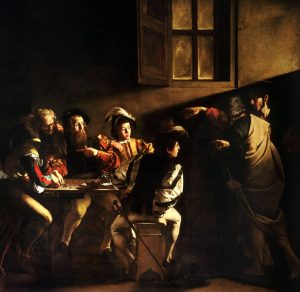
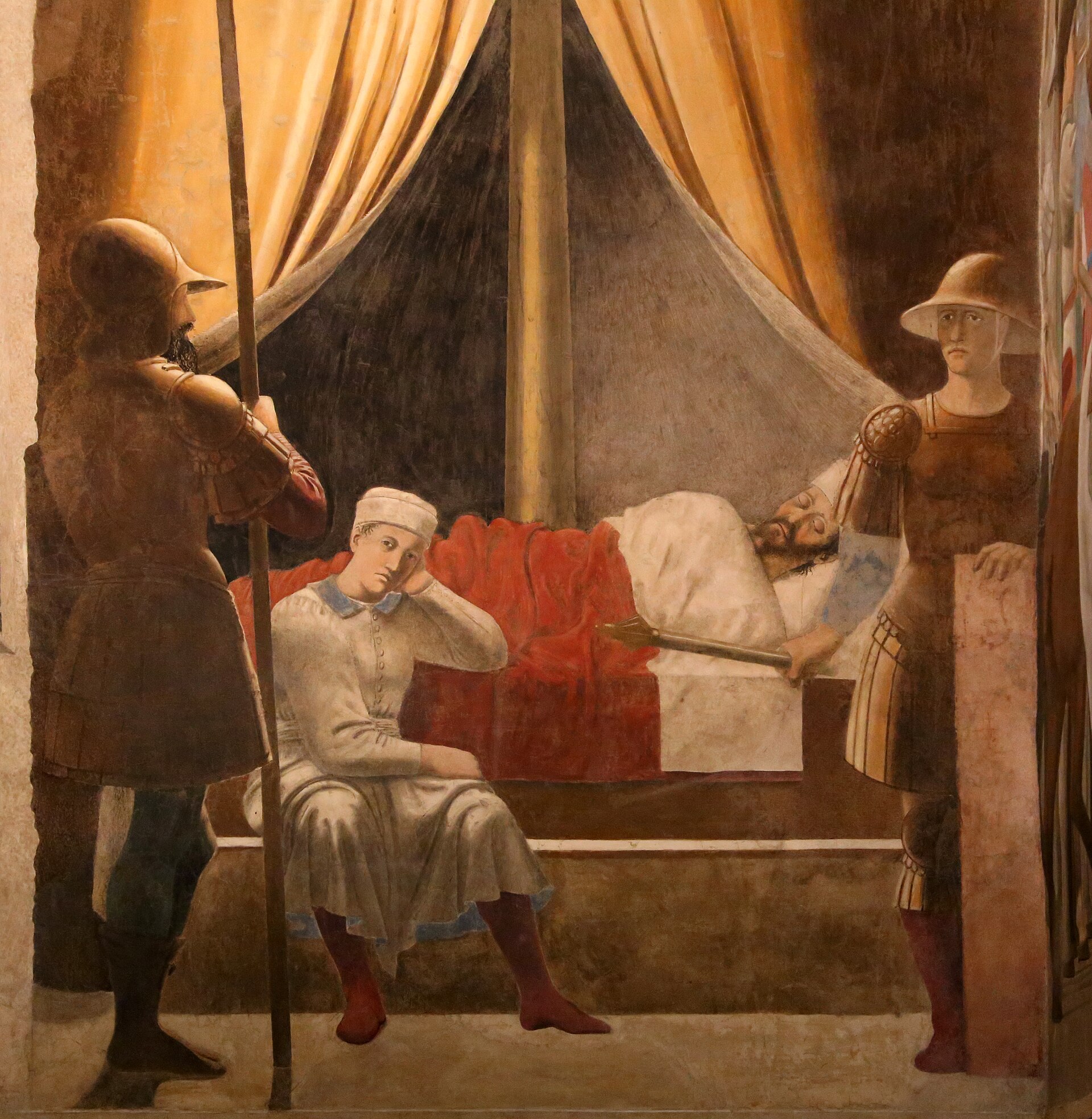
The single most celebrated scene in the cycle is the Dream of Constantine, showing the Roman emperor asleep in a tent on the eve of battle while an angel descends to show him the cross in a vision. It is generally counted among the earliest convincing night scenes in Western painting: the tent’s interior is lit by a small, glowing angel whose light falls across the emperor’s face, the guard beside him and the fabric of the tent itself, with a naturalism and control of a single artificial light source that would not become common in European painting for another century and more. A guard sits half-asleep in the foreground, his lance resting against his shoulder, rendered with the same geometric solidity as the sleeping emperor behind him. The scene occupies a fraction of the wall compared with the crowded battle sequences elsewhere in the cycle, yet it is the image most reproduced on postcards and in textbooks, cited by later painters and historians of light in painting as an early ancestor of the dramatic single-source illumination that Caravaggio and his followers would make their signature more than a century afterward.
Fifteen years to put the wall back together
The frescoes had suffered from damp, salt efflorescence and earlier, poorly executed repair attempts by the time a major restoration began in 1985. The project took fifteen years, with the first six spent simply assessing the damage and undoing the harm caused by prior interventions before any new conservation work could begin, and was completed in the year 2000, after which the chapel reopened to the public with a new system for managing visitor numbers inside the confined space. A separate, smaller conservation campaign addressing the chapel’s stained glass and a thirteenth-century painted cross was carried out in early 2024.
Forgotten, then put back at the centre
For much of the eighteenth and nineteenth centuries Piero della Francesca was a minor figure in Italian art history, admired by specialists but absent from the popular canon that put Raphael, Michelangelo and Leonardo at its centre. The turn came in the twentieth century, driven above all by the Italian critic Roberto Longhi, who had already argued for Piero’s importance in a 1914 essay and then, in 1927, published a full monograph making the case at length. Longhi’s book directly challenged the dismissive assessment offered by earlier critics, including the influential American connoisseur Bernard Berenson, who had judged Piero’s work unemotional and impassive. Within a generation, Piero had moved from a footnote in Tuscan painting to a figure ranked alongside Masaccio and Uccello as one of the founders of Renaissance perspective, a reassessment that fed directly into renewed conservation interest in the Arezzo cycle itself.
Following Piero out of Arezzo
Arezzo is now one stop on what is informally called the Piero della Francesca trail, an itinerary that also takes in his birthplace of Sansepolcro, home to his Resurrection fresco and the Museo Civico‘s collection of his panel paintings; the small Tuscan hill town of Monterchi, where his Madonna del Parto hangs in a dedicated museum; and Urbino, in the Marche, where the Galleria Nazionale delle Marche holds his Flagellation of Christ, one of his most debated panel paintings for the puzzle of who its background figures represent. The Basilica of San Francesco itself remains a working Franciscan church, and access to the Bacci Chapel is managed through timed tickets, with numbers limited inside the choir to protect the frescoes.
Lead image: Piero della Francesca, Dream of Constantine, c. 1452–1466. Basilica of San Francesco, Arezzo.